Understanding the Difference Between Assistive and Adaptive Technology

Individuals with disabilities often depend on various tools to enhance their independence and participation in everyday life. In discussions about accessibility, two terms frequently arise: assistive technology and adaptive technology. While these terms are sometimes used interchangeably, this blog outlines their key differences and explains why that distinction matters as technology becomes more inclusive.


What is Assistive Technology?

According to the Assistive Technology Industry Association (ATIA), assistive technology refers to any item, system, or product used to improve the functional capabilities of individuals with disabilities. These tools are not always explicitly designed for individuals with disabilities; often, they are popular products that can be repurposed or modified for accessibility.

Common examples of assistive technology include:

These technologies not only offer everyday convenience but also play a vital role in supporting independence.


What is Adaptive Technology?

Adaptive technology is considered a subcategory of assistive technology. The key distinction lies in intent and design: adaptive technology refers to devices or equipment created specifically for individuals with disabilities. These are tools that someone without a disability would not typically use.

Common examples of adaptive technology include:

Adaptive technologies are often key to enhancing quality of life, as they provide the tools individuals with disabilities need to engage in learning, working, and living independently.


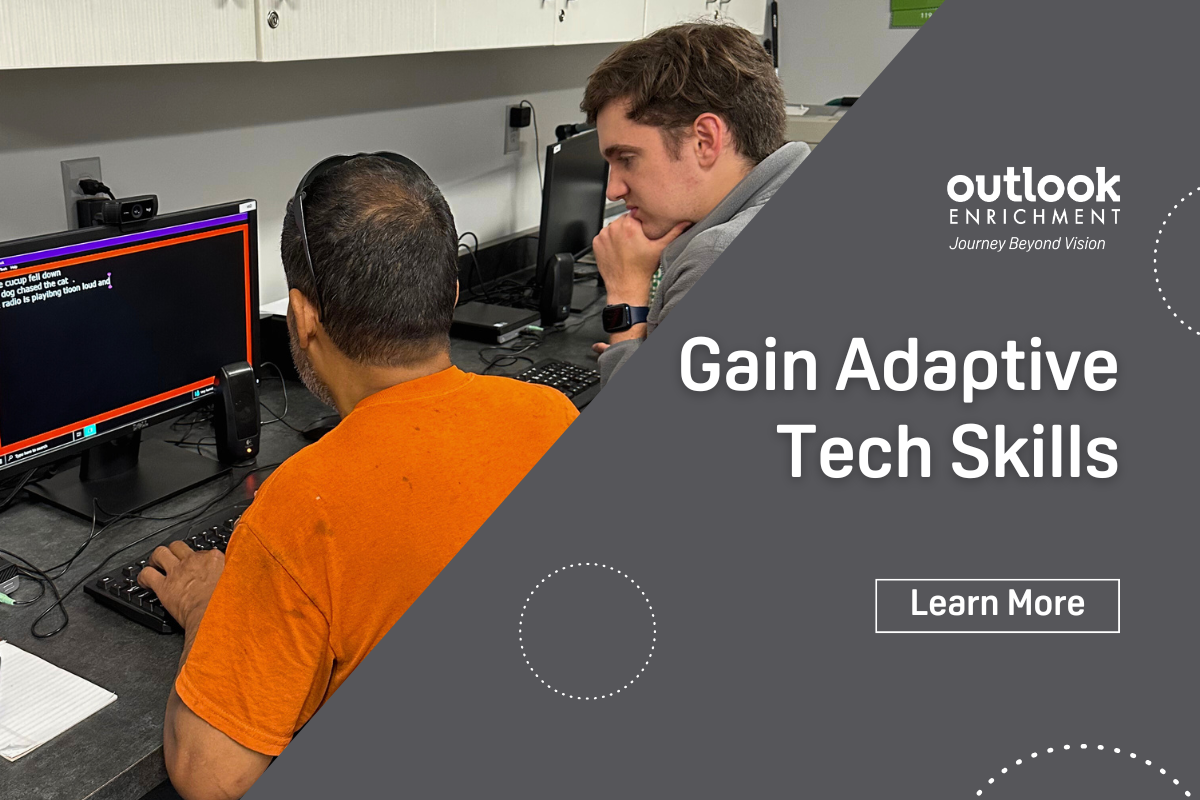
Outlook trainer, Isaac, works with a male client on computer typing skills.


As mainstream technologies increasingly incorporate built-in accessibility features, the line between assistive and adaptive technologies is blurring. Voice control and magnification tools, once considered specialized, are now common features on smartphones, tablets, and computers. This shift represents progress toward a more inclusive future.

If you or someone you know is seeking recommendations for accessibility or adaptive technologies, Outlook Enrichment is here to help. Call us at 531-365-5051 to learn more about our programs or to get personalized recommendations.

Jingles and the Age of AI with Fred Tubiermont

In this episode, we welcome Frederick (Fred) Tubiermont, founder of AI JINGLEMAKER, the creative mind behind the many jingles you’ve heard on our show. Frederick brings a unique perspective to the conversation, combining creativity, technology, and a diverse background.

We dive into the evolving world of generative AI and how it’s being used across industries, from music and coding to accessibility. Fred shares his journey into AI, how he launched AI JINGLEMAKER in 2023, and the future he envisions for AI, from driving innovation to helping users stay relevant by embracing its potential.

A Guide to Accessible Transportation Services in the Omaha Metro Area

One of the most common challenges we hear from associates and clients who are blind or visually impaired is transportation. Reliable, accessible transportation is crucial for maintaining independence, whether it’s getting to work, attending medical appointments, or staying connected to the community.

Fortunately, there are several transportation options available throughout Omaha and the surrounding areas that cater specifically to individuals with disabilities and senior citizens. In this blog, we highlight three categories of services: local special transit services, Metro Transit Omaha, and ride-share and app-based services.
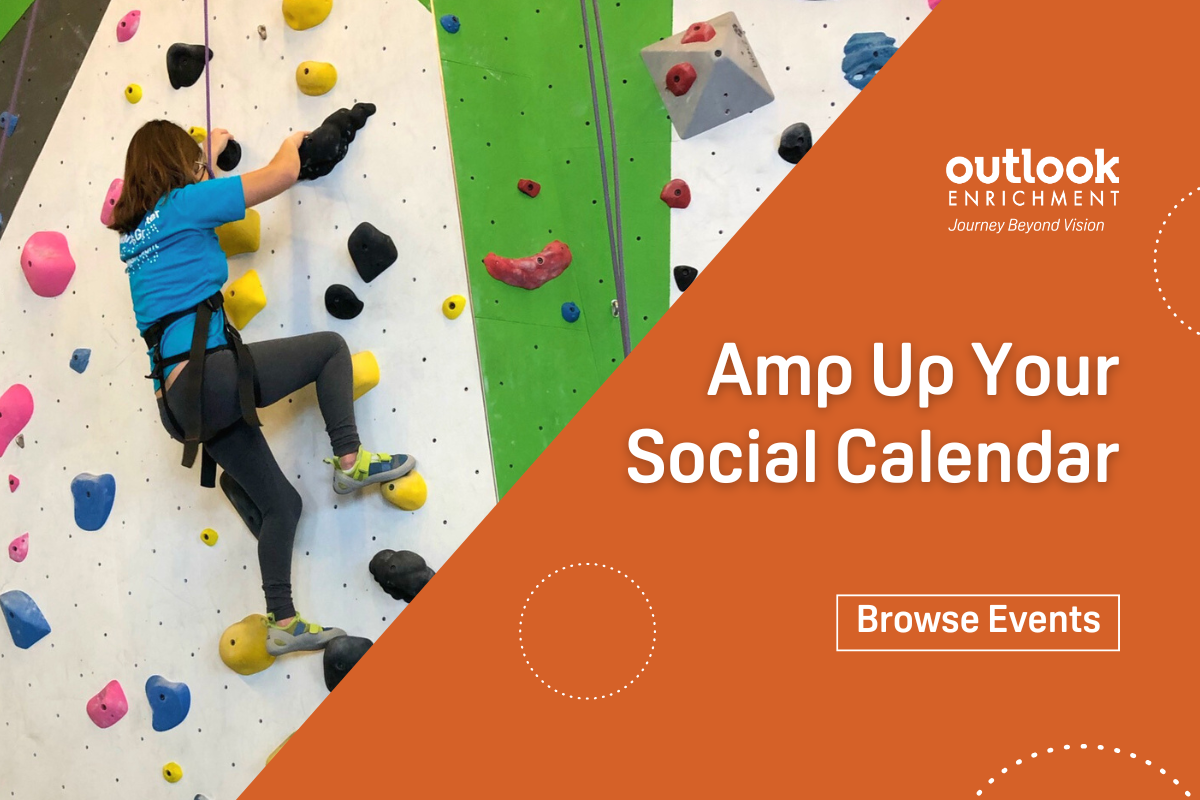
 

"Amp Up Your Social Calendar - Browse Events." A young girl is rock climbing in the graphic.


Special Transit Services Outside of Omaha

Several cities near Omaha provide accessible transportation options primarily for seniors and individuals with disabilities. These services typically require riders to submit applications and make reservations in advance. Cost, travel locations, and operating hours may vary by provider.


La Vista – Ralston Special Services Bus

The La Vista – Ralston Special Services Bus prioritizes work and medical-related trips for senior citizens and individuals with disabilities residing in these areas.

To learn more about the La Vista – Ralston Special Services Bus, click here or call 402-657-3550.


Papillion Special Transportation Services

Papillion Special Transportation Services is an on-demand service subsidized by the State of Nebraska for elderly and disabled residents of Papillion, including those in surrounding SIDs.

To learn more about Papillion’s Special Transportation Services, click here or call 402-680-3970.


Bellevue’s Specialized Transportation Service

Bellevue’s Specialized Transportation Service offers scheduled transportation to destinations in Bellevue and Omaha for senior and disabled residents.

To learn more, call 402-293-3138 to receive an informational brochure and application.


Ponca

Ponca Express offers transportation services for both Native and non-Native individuals. It operates across several Nebraska cities and is available for a wide range of purposes, including medical appointments, education, and recreation.

To learn more about Ponca Express, click here or call 1-877-769-3111 for Ponca Express Rural or 855-766-2239 for Ponca Express Metro.


Council Bluffs Special Transit Service

Council Bluffs Special Transit Service offers accessible transportation for individuals with disabilities who are unable to use standard city buses.

To learn more about Council Bluffs Special Transit Service, click here or call 712-890-5296.


Getting Around Omaha with Metro Transit Services

Metro Transit offers a range of public transportation services throughout Omaha, including traditional bus routes and newer on-demand programs such as Metro Flex, as well as an ADA-compliant paratransit service called MOBY.


Metro Bus System

The Metro bus system includes over 2,100 stops across the Omaha area.

Download from the App Store or Download from the Google Play Store

To learn more about the Metro Bus System, click here.


Metro Flex

Launched in 2025, Metro Flex is a pilot on-demand service that connects riders to nearby bus routes and transit centers.

To learn more about Metro Flex, click here.


ORBT

ORBT is Metro’s streamlined bus service offering faster rides.

To learn more about ORBT, click here.


MOBY

MOBY is Metro’s ADA complementary paratransit service for individuals who can’t access Metro’s fixed route bus network due to a disability or disabling health condition.

To learn more about MOBY, click here or call 402-341-7560, ext. 2520 for assistance.


Ride-Share and App-Based Transportation Options

If public transportation isn’t the right fit for you, ride-share apps and taxi-style services provide additional flexibility.


Uber

Uber is one of the most popular ride-share apps, allowing you to schedule a ride instantly or in advance.

To learn more or download the app, click here.


Lyft

Lyft offers features similar to Uber, with real-time and scheduled rides available through its app.

To learn more or download the app, click here.


zTrip

zTrip is a taxi-style ride service available in Omaha.

To learn more about zTrip or download the app, click here.


Share a Fare

Share A Fare is a transportation reimbursement program for individuals who are legally blind or whose vision prevents them from driving.

To learn more about Share a Fare, click here.
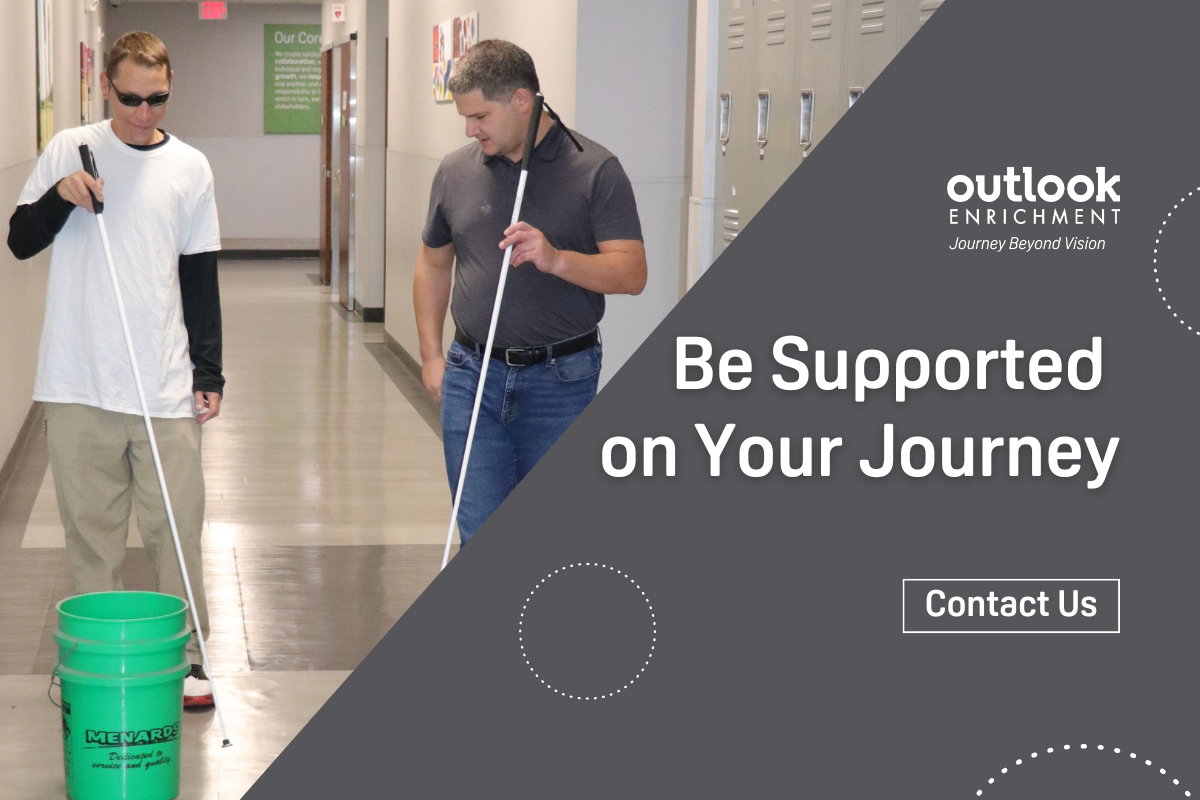
 

A male client practicing cane travel with a male trainer. "Be Supported on Your Journey - Contact Us."


Accessible transportation is essential for staying active, independent, and connected to your community. Whether you’re in Omaha or a neighboring city, there are a variety of options designed to support your mobility needs and busy schedule.

If you or someone you know is blind or visually impaired and needs help navigating transportation options, Outlook Enrichment is here to help. Our Resource Advisor can guide you through the available programs, assist with applications, and help you find the best tools to support your lifestyle. Complete our contact form to get started.

What’s New in Adaptive Technology

In this episode, we’re joined by Adaptive Technology Trainer, Isaac Grelk, and Technology Specialist, Mickie Saltzman. They share their personal stories with vision loss and reflect on their experiences supporting the blind and visually impaired community.

Together, they explore recent advancements in accessibility and adaptive technology, highlighting tools that are empowering individuals to live more independently.

Meet the Enrichment Team: Isaac Grelk

Isaac Grelk understands firsthand the challenges of adjusting to life with vision loss, but he also knows how to thrive despite it. Now, as an Adaptive Technology Trainer at Outlook Enrichment, he’s using his lived experience to support others on their journey toward independence, confidence, and connection. Read on to learn how his journey led him to empowering others.


Isaac’s Early Signs and Diagnosis of Stargardt Disease

Isaac’s vision loss first became apparent to his parents when he struggled to connect with the ball during little league baseball. After two years of tests, he was diagnosed with Stargardt disease, a genetic eye condition that leads to a fatty buildup in the macula, affecting central vision. He explained that both of his parents are gene carriers, and one of his siblings has also been affected. While his vision has remained stable over the years, he acknowledges that it could change with age. Isaac describes his vision as similar to looking around a fist held in front of his nose, explaining that he has a blind spot in the center of his field of vision.

After moving to Omaha in 2016, he was first connected with Outlook Enrichment when his mother discovered the organization online. It provided him with a great opportunity to make new friends who are also blind or visually impaired during high school and to stay active in recreational programs.

Isaac later attended the University of Nebraska at Omaha (UNO), where he earned a bachelor’s degree in kinesiology. When asked why he chose that path, he said, “I always liked helping people achieve their goals, whether fitness-related or something personal.”


Embracing Blindness and Finding Personal Success

One of Isaac’s greatest ongoing challenges has been transportation. For a long time, it was difficult for him to get around independently, as he had to rely on his wife or services like Uber or Lyft, which could be costly. This changed when he moved to La Vista and discovered the La Vista-Ralston Special Services Shuttle. He was grateful for a simple application process, having only to fill out a form and hand it to the driver on his first ride. This smaller, more localized service has provided greater flexibility, and the drivers have even learned his routine, so he no longer needs to call ahead to schedule each ride.

In terms of personal growth, Isaac has had several milestones worth celebrating:


Empowering the Blind Community Through Community Programs

Towards the end of college, Isaac’s involvement with Outlook Enrichment deepened when he took on an internship with Outlook Enrichment as part of his practicum at UNO. He landed the internship after an associate overheard him on a tour saying, “This would be a neat place to work.” That small moment turned into a big opportunity.

During his internship, he taught CrossFit classes to clients through our health and wellness program. He also trained his peers to adapt workouts and to follow proper etiquette when interacting with individuals who are blind or visually impaired.

After completing his internship and graduating from college, Isaac transitioned to the manufacturing floor at Outlook Nebraska, gaining experience on the employment-focused side of our organization. When an Adaptive Technology Trainer position opened at Enrichment, he knew it would be a perfect fit.

Today, Isaac works directly with clients, teaching them to navigate technology using accessibility features such as screen readers, voice commands, typing tools, AI, and more. When asked what he enjoys most about the role, Isaac didn’t hesitate:

“The moment clients realize they can independently use their phone again, that ‘ah-ha’ moment is the best.” He always reminds them, “You can do a lot more than you think you can.”


Outlook trainer, Isaac, works with a male client on computer typing skills.


Isaac’s story is a powerful reminder that vision loss doesn’t define a person; it simply reshapes how they experience the world. From learning to adapt at a young age to becoming a trusted tech trainer at Outlook Enrichment, he has embraced his identity and now helps others do the same on their journeys towards independence.

Interested in training with Isaac? Let’s get in touch!

A Veteran’s New Chapter: Josh Scarborough’s Story

With Veterans Day taking place this month, we’re spotlighting one of our own, Josh Scarborough, a veteran whose journey has taken him across the globe and ultimately led him to embrace a new chapter at Outlook Nebraska.

From active deployment to navigating the challenges of vision loss, Josh’s story is a powerful reminder that with the proper resources, it’s possible to rediscover purpose, rebuild confidence, and let your inner light shine.


Josh’s Path to Service in the U.S. Army

Josh was born in Upper Michigan and raised in Florida, growing up in a military family that was often on the move. He decided to enlist in the Army at 17, motivated by a desire to improve his life by changing his environment and building a more positive future. One of the benefits of serving was the opportunity to take college courses, which he noted is strongly encouraged within the military. During his service, he earned a degree in Military History and a minor in Military Science.

After choosing to enlist in the Army, he completed academic tests and physical exams to determine his Military Occupational Specialty (MOS), aiming for a role he described as “cool”. Initially, he was set to be a gunner/crewman for the BMG-71 TOW, but when that position was phased out, he shifted to Direct Fire Infantry, where he spent most of his military career. Josh served in multiple units, including mechanized, air assault, light infantry, and combined arms.  


The Highs and Hardships of Infantry Life

Josh is not one to sit still. “I didn’t like garrison life,” he admitted, referring to his time spent on base. Instead, he preferred deployment and was often in the U.S. for only 2 to 3 months at a time. He shared that while you can have a wish list of preferred deployment locations, it ultimately depends on what your branch manager can arrange. His favorite deployments were to South Korea, where he spent four to five years stationed around the country from the DMZ (Demilitarized Zone) to the city’s capital, Seoul. Over the years, his service took him to other places as well, including Iraq, Afghanistan, Africa, and the Philippines, and even across the ocean by ship while guarding equipment.

However, life in the military comes with risks and tribulations. During his first enlistment, Josh began experiencing vision issues, especially at night, even while using night-vision equipment. He realized that a series of multiple injuries, including concussions and traumatic brain injuries (TBIs), sustained from improvised explosive devices (IEDs), were damaging his vision. One incident he recalled occurred during the surge in Iraq. He was riding in a Humvee when it flipped from impact, pinning him in a canal. This incident resulted in a concussion and a neck injury, requiring him to be medically evacuated to Germany. After 11 years of service, Josh separated from the Army. Having to start a new chapter in life, Josh chose to move near his sister, his closest relative, who was stationed at Offutt Air Force Base. 


Finding a New Home at Outlook Nebraska

Within just a few months of moving, Josh learned about Outlook Nebraska and was quickly hired on the manufacturing floor.  Today, Josh works as an Operator at Outlook Nebraska and continues to enjoy the hands-on nature of his job. One of his favorite activities during his shift is listening to audiobooks. “I loved reading as a kid; it keeps my mind and creativity going,” he shared.

Transitioning to life with vision loss wasn’t easy. He described the most challenging part as figuring out where to seek help and learning how to adapt to new technology. Through Outlook Enrichment, he learned to use a cane and accessibility features such as Magnifier on his phone.

He described his current vision as limited to shadows with his left eye, fuzzy tunnel vision in his right eye, and difficulty seeing in low-light conditions. Despite these challenges, Josh is grateful for Outlook Nebraska and the support he’s received. “I’ve met some really good, patient people. I had some adapting and growing up to do, and I don’t know where I’d be without Outlook. I love working; it keeps me busy.”


Terra is packing toilet paper on the manufacturing floor. "Career Opportunities That Build Brighter Futures - Learn More."


This Veterans Day, we honor Josh and all who have served. When asked what advice he would give to fellow veterans facing similar challenges, Josh said, “There are organizations that can help you. Your biggest obstacle is yourself.” Regarding his experience working at Outlook Nebraska, he added: “Outlook Nebraska lets you succeed and grow as much as you want to and are capable of.”

If you or a loved one is a blind or visually impaired veteran seeking support, whether through our community programs or employment, we’re here to help. Please complete our Employment Interest Form or contact Outlook Enrichment to get in touch.

Let’s continue to uplift and empower those who have sacrificed so much in service to our country.