Guide Dogs 101: Etiquette Tips and Interviews from Outlook Associates

Guide dogs are an invaluable and trustworthy option for blind or low-vision individuals seeking to enhance mobility and safety. In recognition of National Guide Dog Month this September, we’re sharing tips for interacting with guide dogs and personal stories from two Outlook Nebraska associates about their journeys beyond vision and experiences with guide dogs.


Understanding the Role of Guide Dogs and Proper Etiquette

Every service dog serves a distinct purpose, and guide dogs are no exception. They are trained to assist individuals who are blind or have low vision with mobility. While both guide dogs and emotional support dogs play vital roles and are trained to aid their owners in times of need, there are critical differences in their accommodations.

Under the Americans with Disabilities Act (ADA), state and local governments, businesses, and nonprofit organizations that serve the public must allow service animals to accompany people with disabilities in all areas where the public is permitted. In contrast, an emotional support animal (ESA) is not considered a service animal under the ADA because its assistance is not directly related to an individual’s disability. Different regulations apply to individuals with ESAs, which are protected by federal and state laws. To qualify for an ESA, owners must obtain a letter from a licensed mental health professional, which may be required for travel and housing under the Air Carrier Access Act and Fair Housing Act.

Proper etiquette for interacting with guide dogs is essential. They are always considered “at work” and should not be distracted or petted.

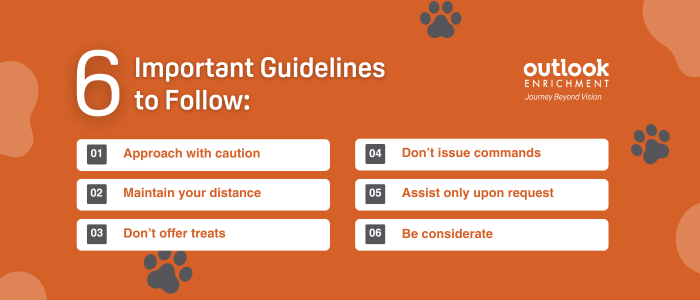
Here are some important guidelines to follow:


Graphic with paw prints and text: "Guide Dog Etiquette - 6 Important Guidelines to Follow: approach with caution, maintain your distance, don't offer treats, don't issue commands, assist only upon request, and be considerate."


Empowerment Through Partnership: Jose Castañeda and Tiberius

A few years after relocating to Omaha with his family to escape gang-related violence in Los Angeles, 20-year-old Jose Castañeda was involved in a car accident that temporarily blurred his vision, making everyday tasks much more difficult. The accident shed light on the genetic condition that he was born with, known as retinitis pigmentosa (RP). Growing up, he was aware of his mother’s vision loss but didn’t know what RP was or the challenges it could bring.

Fortunately, his sight returned after a few months, allowing him to continue driving for another 10 to 15 years. However, as his condition progressed, Jose eventually faced the difficult decision to stop driving to prioritize his safety. Reflecting on the accident, Jose believes it may have triggered or accelerated the effects of his RP, leading to a more rapid decline in his vision. With the help of an eye doctor, he gained a deeper understanding of RP and how it could affect his future.

Jose’s vision loss eventually led him to seek employment on the manufacturing floor at Outlook Nebraska, where he has been for over twenty years. He started his career with First Star Fiber before Outlook Nebraska transitioned into a separate organization in 2002. While working at Outlook, another associate suggested that a guide dog might benefit him. Jose explained that he struggled with cane travel, as his partial vision often made him second-guess the cane’s guidance. He found himself wanting to rely on the vision he had left, which led to a lack of confidence in his navigation. This was a pivotal moment in his journey beyond vision as he realized a guide dog would offer greater independence and boost his confidence in his mobility.

The process for applying for a guide dog was straightforward, requiring him to select an agency to go through (The Seeing Eye), complete an application, and submit references. Upon approval, they flew him to Morristown, NJ, to begin training, which took four weeks for his first dog and three weeks for his current dog, Tiberius. Jose says, “They can be a lot of work, but it’s well worth it.” Jose continues to use clicker training to help Tiberius get accustomed to a new environment he will frequent.

Jose says, “We are like a team. We have to work together. At work, he knows everyone and is friendly. But when we travel, he works 110%. He doesn’t stop and say hi. He’s working hard and knows we are on a mission.”


Curiosity Creates an Expert Handler: Mitch Green and Anakin

Just as every journey with vision loss is unique, so is every owner’s experience and reasoning behind applying for a guide dog. Mitch Green, Outlook’s IT Manager, has been with us for 13 years and is now on his third guide dog (Anakin), making him an expert with the process. Due to his premature birth, Mitch has been blind his entire life. His experience with guide dogs started when he was 19, when he had the opportunity to head to Florida to work with Henter-Joyce (now Freedom Scientific), the creators of JAWS.

One afternoon, he joined co-founder Ted Henter for a trip to the beach. As Mitch ventured towards the water, something remarkable happened – Henter’s guide dog instinctively tried to guide Mitch back to shore. This was unusual, as guide dogs typically form a strong bond with their owner and are trained only to guide them. However, Mitch explained that Henter and his dog struggled to connect. This moment sparked Mitch’s curiosity about guide dogs and the process of obtaining one. As a result, Mitch applied to Guiding Eyes for the Blind in New York and was accepted when he turned 21.

He recalls the process, which required references, a physical exam, and details about his home environment. After applying, a field representative visited his home to verify his address and ensure it was safe for a guide dog. Mitch underwent four weeks of intensive training and was paired with his first guide dog, Upton. During training, the instructors took his cane away, allowing him to focus entirely on navigating with Upton and getting familiar with the facility. Mitch also trained on the busy streets of New York, stating, “If I could navigate there successfully, I knew I could travel anywhere.”

During training, instructors assess each trainee’s walking speed, the strength of pull required for directional guidance, and their responsiveness to cues, including stopping. This information helps the organization to create a detailed profile for each trainee to ensure an accurate match with a potential guide dog. While guide dogs are specifically trained for mobility purposes, Mitch noticed that his current dog, Anakin, started to detect fluctuations in his blood sugar levels over time. He believes their strong bond has enabled him to recognize these changes. He has found Anakin fairly accurate, often alerting him before his insulin monitor goes off.


Woman on laptop. Text: "Be Supported on Your Journey. Join us for our weekly virtual peer support group sessions." Contact Us link.


Today, the total cost of travel and training for a guide dog can reach up to $50,000. Fortunately, numerous nonprofit organizations in the United States offer these services at no cost to owners. While each owner’s reasons for getting a guide dog may differ, they offer more than just enhanced mobility; they can boost confidence, foster independence, and provide valuable companionship. Although it’s important to remember that they are a significant responsibility. Despite potential challenges, as Jose and Mitch can attest, the benefits outweigh the challenges. To learn more about Outlook Enrichment’s services and programs, contact us at 531-365-5051.

Meet the Enrichment Team: Megan Mackie

Embracing the unknown can often be daunting when thinking about one’s future, dealing with the unexpected, or simply leaving behind our comfort zones. For this interview series, we sat down with each of our Outlook Enrichment associates to spotlight their expertise within their roles and share their personal stories regarding their journey beyond vision. Meet Megan Mackie, Outlook Enrichment’s Community Events Coordinator.


Growing Up with Diabetic Retinopathy

Born in Omaha, NE, Megan’s childhood was much like any other until her juvenile diabetes diagnosis at age three. Despite the diagnosis, she remained determined not to let it dampen her spirits or slow her down. Throughout her childhood, her parents stressed the importance of managing her condition to stay healthy, though, as a child, it wasn’t always her top priority. It wasn’t until after graduating from college that she became aware of a decline in her vision. Suddenly, everyday activities such as reading and driving became increasingly difficult.

In 2010, she was diagnosed with diabetic retinopathy after one of her retinas detached, and the same thing happened to her other eye in 2011. Prioritizing her independence over her safety, she made the difficult choice to stop driving. Hoping surgery to reattach her retinas would restore her vision and allow her to drive again, she remembers this period as a source of optimism. 


Navigating New Challenges Associated with Low Vision

While this was happening, Megan had been serving at the same restaurant for years. She slowly realized that she could no longer navigate the restaurant as easily as she once could. It felt like another aspect of her independence was being taken away, and she knew there would be new challenges to overcome. She needed to learn how to apply for Social Security Disability Insurance (SSDI) and about cane travel. Unsure of where to seek help, Megan contacted the Nebraska Commission for the Blind (NCBVI).

Little by little, she became more comfortable with using a cane to get around. She began by walking her dog and traveling solo around her neighborhood. As she grew more confident, she attempted walking to the grocery store and maneuvering through the aisles. While it wasn’t the same level of independence she was accustomed to, NCBVI helped rebuild some of her confidence, and she found comfort in knowing that others were dealing with similar obstacles.


Breaking Stereotypes and Embracing Leadership

Despite facing challenges with her declining vision, Megan has reached a point of acceptance and continues to adapt to life’s obstacles. In 2018, she learned about Outlook through a former associate and decided to apply for the Front Desk Receptionist position. The following year, Megan became the Community Events Coordinator for the Enrichment team and has loved it since. She appreciates the critical life skills her position and diagnosis have taught her, such as flexibility, adaptability, and problem-solving.

Every day, she aims to challenge the stereotype of what’s achievable. Whether that involves pushing the boundaries of what event participants can accomplish, surprising community members who have not witnessed a group of blind individuals cycling together on a Group Therapy ride, or participating in shooting activities. When she’s not leading enrichment events, Megan enjoys being with her five dogs and foster pup, walking, and planting flowers.


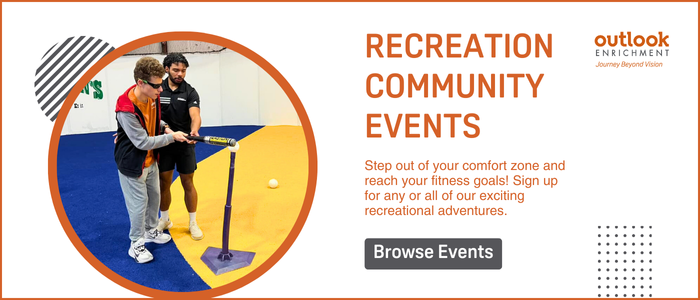
Volunteer helping youth participant tee off for beep baseball. Text: "Recreation Community Events - Step out of your comfort zone and reach your fitness goals! Sign up for any or all of our exciting recreational adventures. Browse Events."


At Outlook Enrichment, we are grateful to have an associate who shares positivity and strength with everyone who walks through our doors or attends our events. She believes there’s strength in numbers, recognizing that one person’s weakness may be another’s strength. This is Megan Mackie’s journey beyond vision. To learn more about Outlook Enrichment’s services and programs, contact us at 531-365-5051.

Meet the Enrichment Team: Ross Pollpeter

Embracing the unknown can often be daunting when thinking about one’s future, dealing with the unexpected, or simply leaving behind our comfort zones. For this interview series, we sat down with each of our Outlook Enrichment associates to spotlight their expertise within their roles and share their personal stories regarding their journey beyond vision. Meet Ross Pollpeter, Outlook Enrichment’s Program Manager.


Turning a Diagnosis into Determination

Reflecting on his childhood, Ross recalls the first signs of his vision loss, having difficulty seeing at night and losing sight of pitches mid-air during youth baseball. Despite these challenges as a child, he didn’t think much of it then. However, when his older brother John was almost in a car accident and later diagnosed with retinitis pigmentosa at the age of 16, his parents decided to have the rest of the siblings examined. This eye exam is how Ross, at 11 years old, discovered that he had the same genetic eye condition.

Although he initially feared and struggled internally with his diagnosis, sharing the same experience with his sibling provided comfort during a difficult time. His perspective on his diagnosis changed when he connected with the Iowa Department for the Blind (IDB). This was his introduction to a community of blind individuals. After touring the IDB and receiving training such as cane travel, braille, and adaptive technology, his future opened to a world of possibilities.


How Ross Found Purpose in Skills Training

After college, Ross returned to IDB and graduated from their training program, where he met his wife, Bridgit. Ross continued to be inspired by the impact of skills training and saw nonvisual techniques as an investment for his future. Ross soon accepted a position at the League of Human Dignity, where he worked for eight years as a Barrier Removal Program & Independent Living Advisor.

Wanting to pursue a career where he could be his own boss, Ross transitioned to a new role at the Nebraska Commission for the Blind and Visually Impaired (NCVBI), where he joined their Nebraska Business Enterprise Program. Here, he contracted out four facilities and over 60 vending machines, learned how to manage money and inventory, and tracked sales independently and successfully, thanks to his previous skills training.

Eventually, Ross’s passion for skills training led him back to IDB, where he became a Vocational Rehabilitation Teacher. Here, he taught cane travel, braille, and more. This role reinforced his desire to help others gain confidence and master crucial skills, making him a strong candidate for his next role.


Transforming a Teaching Career into a Leadership Role

While Ross enjoyed his current teaching role, he was seeking a role that would allow him to showcase his leadership skills. Fortunately, Ross recently connected with Outlook through his network and became involved in our community events, including the annual gala, Vision Beyond Sight. After discovering an opening, Ross joined the Enrichment team as the Program Manager in the fall of 2023.

As a leader, Ross’s expertise enables him to help clients reach their goals, whether it involves skills training at our facility, independent living training in clients’ households, or facilitating our peer support group. He believes the most rewarding aspect of his role is witnessing individuals gain self-confidence as they master new skills. He says, “Skills training is like muscle building. You have to keep doing it to get stronger. If you stop, it weakens.”


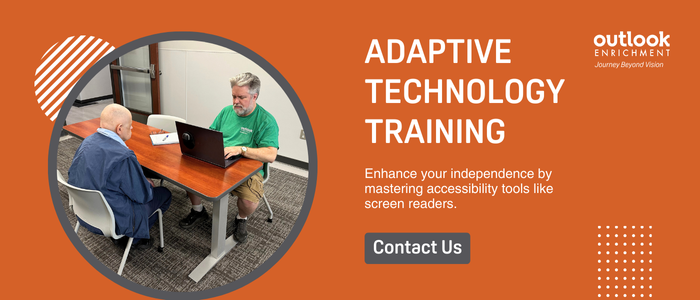
Enrichment Adaptive Tech Trainer, Dennis, working with Outlook Nebraska associate on utilizing adaptive tech skills on a laptop. "Enhance your independence by mastering accessibility tools like screen readers. Contact Us."


While every journey has its highs and lows, our ability to overcome and challenge mental and physical barriers will determine our future. This message and Enrichment’s unwavering support are what our clients will remember when they walk out our doors. This is Ross Pollpeter’s journey beyond vision. Discover how we can help you or a loved one on their journey. Let’s get in touch.

2023 Vision Beyond Sight Gala

2023 Gala Recap

On the evening of Friday, October 13, we held our annual Vision Beyond Sight Gala at the Marriott Downtown in the Capital District. We extend our heartfelt gratitude to our associates, Alex Curtis and Rachel Carver, for graciously sharing their inspiring stories with all in attendance.

We want to express our sincere thanks to all the attendees, volunteers, sponsors, and generous donors. The success of this event, as well as Outlook’s vital work, would not have been possible without your unwavering support. It was a night brimming with moments of joy, tears, and anticipation. During the “Dessert in the Dark” segment, our attendees had the opportunity to empathize with the experience of those who are visually impaired by sampling desserts they couldn’t identify.

This year, our silent auction was a resounding success, thanks to the generous contributions of items and enthusiastic bidding from everyone. Rest assured, we are already working hard to prepare for next year’s event.

Awards

For those who were present and those who couldn’t make it, we invite you to view our Associate of the Year, Volunteer of the Year, and Lifetime Achievement videos below.

How Rachael Found Confidence & Freedom

Rachael’s Diagnosis

In September 2014, Rachael was diagnosed with stage four ovarian cancer and began chemo treatments, and by March 2015, Rachael had finished her fourth treatment. Rachael started noticing changes in her vision, and “things were getting blurrier.” Rachael believed that her eyes were changing with age and waited until she was done with her chemo treatments to see an eye care professional.

Thinking she just needed glasses, she went to a big box optical center with her sister-in-law since she no longer felt safe to drive. During the visit, Rachael discovered she couldn’t read anything below the first line of text on the eye chart. The optician began to write a prescription, not divulging that in her current vision, she was classified as legally blind until her sister-in-law asked the doctor when Rachael was told that she was now legally blind.

Over the next year, Rachael was connected to several eye care professionals and had extensive testing. Rachael was eventually informed that she had bleeding in her retina and significant scarring in her eyes. She eventually was sent to a retina specialist, who later sent her to a neuro-ophthalmologist. After numerous hours of testing, Rachael still had no answers. At a loss, it was recommended that she see a low-vision specialist and prepare for a future without vision.

At this same time, Rachael went in for a routine check-up on her cancer and was informed she needed additional chemo treatments. As the treatments progressed, Rachael experienced a continual loss of vision, to the point that she could no longer see facial features and could only see silhouettes. Eventually, all central vision was lost, and peripheral vision slowly dwindled to nothing. By the beginning of 2017, Rachael had no vision left. 

The Impact of Rachael’s Vision Loss on Her Well-Being

Her doctors encouraged her to see an eye doctor, but Rachel was resistant and did not see the point of seeing an eye doctor because she was blind. In May of 2020, Rachael was finally connected with someone who could give her some answers. Rachael was told she had cancer of the eye, and in June 2020, her left eye was removed.

Rachael pulled back from all social activities, limited her interaction to only her family, and rarely left her home. She found herself slipping further into depression and felt vulnerable and alone. With the vision loss, she could no longer help others in her family, was angry, and felt helpless because she needed so much assistance to complete tasks. “I felt like I no longer had control over my life.”

Gaining Acceptance and Seeking Support

Rachael reached out to Outlook Enrichment in January 2022. She was at the end of her rope and felt distraught, lonely, and useless. “It was a very tear-filled conversion.” Rachael was emotionally at her breaking point. As she talked to staff who described services, Rachael started to see that there was hope after being told for so long that nothing could be done.

“I started to see there was hope and people genuinely cared about me. I never heard we can’t help you with that, all I heard was, you can do it. We just have to figure out the right way. I felt like someone had tossed me a life preserver and was told to hold on tight.”

Rachael initially started receiving training in Adaptive Technology and received an individualized adjustment to blindness services to assist with the changes she now faces and the emotional grieving process.

As Rachael became more confident, she started taking Moby transportation by herself. “It was a big day. I was so proud of myself.” Rachael had new freedom and confidence not experienced in a long time. Gradually, she joined more Enrichment programs. Rachael regularly participates in the Color Outside the Lines arts program and is an active member of the weekly support group, sharing and empowering others through her Journey.

2022 Outlook Enrichment Donor List

Explore Outlook Enrichment’s 2022 Donor List. We are grateful to have a diverse and generous list of contributors who support our mission and efforts.

Business & Community Group Donors

A United Automatic Doors & Glass Inc
BG Peterson Company
Blair Lions Club
Boys Town National Research Hospital
Community Club Tours
Echo Electric Supply
Erickson & Sederstrom, P.C.
Fareway
Feltz WealthPlan Partners
General Fire & Safety
Goodwill Omaha
Great Lakes Tissue
Gretna Lions Club
Heritage Gold Club – Partners Bank
Kirsch Transportation
Korber Tissue North America
Lukas Partners
Maflex America, Inc.
Murdock Lions Club
Omaha CPCU Society Chapter
Palmer Fixture
Papillion Area Lions Foundation
Pintail Consulting
Pond
Rejoice Lutheran Church
Ricoh USA
The Makery
The Weitz Company
Titanium Fire Sprinkler
Trebor Inc
UMB Bank
UNICO Group
Valentine Community Schools District No. 6
Vistage Omaha
West Gate Bank

Foundation Supporters

Gilbert M & Martha H Hitchcock Foundation
Kleinberg Family Foundation
Mammel Family Foundation
Manota E Simon Foundation
Mutual of Omaha Foundation
National Council of Jewish Women Nebraska
National Philanthropic Trust
Omaha Community Foundation
Robert Herman Storz Foundation
Rupert Dunklau Foundation
The Ethel S Abbott Charitable Foundation
The Stanley M Truhlsen Family Foundation Inc
William & Ruth Scott Family Foundation

Individual Donors

Pete Adams
Kaitlin Ahart
Paul Ailslieger
Eric Arneson
Bob Arp
Derek Babb
Matthew Baer
Kim Balkovec
Dana Behlen
Wade Behlen
Michael Bjornstad
Steven Bolinger
Bryan Brabec
Joshua Burnett
Jason Campbell
Mike Campbell
Rachel Carver
Linda Clemmons
Bob Corn
Francis Daniels
Janice Denton
Joan Dickman
Jeffrey Dobson
Bart/Kim/Vincent/Trisha Drage
Alyson Dreyer-Benes
Mary Ann Duda
Brad Eagles
Arthur Eisenbeisz
Kathern And Vernal Faller
Janet Farber
Linda Felber
Marianne Franks
Carol Gibilisco
Christopher Goble
Kristin Gochenour
Michael Graverson
Tim Green
Barbara Greenspan
Jody Grewe-Gasnick
Jason Gustafson
Scott Haddick
Scott Herman
Philip Hezeltine
Ken Higgins
Barb Hillestad
Susan Hodges
Elizabeth Hosford
Joseph Hrdy
Joseph Hrdy
Mark & Linda Ingalls
Rebekah Jerde
Chris Johnson
R.C. Johnson
Dan Kassmeier
Dan Kassmeier
Richard Kelley
Ann Kelsall
Aundra Kohlbeck
Jacquelyn Kraenow
Allison Kroupa
Shubhasish Kundu
Nancy Kurtenbach
Janet Laird
Greg Larsen
Sarah Lieske
Ben Loosbrock
Randall Luebe
Charlee Malsbury
Elizabeth Marsolek
James McDowall
Nicholas McGrath
Keri Menage
Lori Mitera
Brian Mlnarik
Elsie Monthei
Amy Monthei
James Moore
Jack Moylan
Jane Nielsen
Mark Nielsen
Brook Nolin
Linda Norwood
Carrie Novak
Troy O’bey
Chuck Oddo
Daniel Palmquist
Kathleen Park
Beatrice Payne
Dana Payne
Dan Pennington
Ashley Perdunn
Kristal Platt
Brad Poelstra
Michelle Poteet
Steve Proctor
Chad Richter
Martin Ricks
Nina Rongisch
Eric Rose
Greg Rosener
Robert S & Sheila J Runyon
Carol Russell
Terry Schaefer
Louise Schafer
Scot Schoenwalder
Sally Schreiner
Dan or Carla Schwantes
Robert Scott
Nancy Scott
Richard Secor Jr
Barb Sichmeller
Cindy Singer
Michael Sloan
Troy Solsaa
Alex Spanel
Kevin Stratman
Eric Stueckrath
Ryan Swinton
Travis Tauer
Karen Thomas
Jeffery Thompson
Katie Todd
Chris Topf
Margaux Towne-Colley
Doug Troupe
William Truhlsen
Zach Udesen
Mary Underwood
Sandra Vandersnick
Albert Vitamvas
Tamara Ward
Brett Wehling
Lynn Williams
Sean Williams
Gerald Winkelbauer
Jeffrey Winkelbauer

In-Kind Donors

14 Karat
A & J Designs
A Catered Affair
Bounce U
Detail Rat
Exceptional Portraits
Francine & Harper
Gallivita: A Travel Experience Company
Indian Creek Golf Course
Maflex America, Inc.
Omaha Children’s Museum
Omaha Marriott Capitol District
Oscar’s Pizza Sports Grille
Palmer Fixture
Pintail Consulting
Rocket Carwash
The Makery
TreeRush Adventures
Village Pointe Shopping Center