The Early Days of Outlook Nebraska with Janis Compton

In this episode, we welcome Janis Compton, a well-known figure in the history of Outlook Nebraska. As the organization’s first receptionist, Janis wore many hats, stepping in wherever she was needed and helping lay the foundation for what Outlook has become today.

She shares a glimpse of her role, reflects on Outlook’s early days, and discusses what makes it such a special place to work. Janis also gives us an update on what she’s up to now and a few of her favorite hobbies that keep her busy.

What’s New in Adaptive Technology

In this episode, we’re joined by Adaptive Technology Trainer, Isaac Grelk, and Technology Specialist, Mickie Saltzman. They share their personal stories with vision loss and reflect on their experiences supporting the blind and visually impaired community.

Together, they explore recent advancements in accessibility and adaptive technology, highlighting tools that are empowering individuals to live more independently.

A Veteran’s New Chapter: Josh Scarborough’s Story

With Veterans Day taking place this month, we’re spotlighting one of our own, Josh Scarborough, a veteran whose journey has taken him across the globe and ultimately led him to embrace a new chapter at Outlook Nebraska.

From active deployment to navigating the challenges of vision loss, Josh’s story is a powerful reminder that with the proper resources, it’s possible to rediscover purpose, rebuild confidence, and let your inner light shine.


Josh’s Path to Service in the U.S. Army

Josh was born in Upper Michigan and raised in Florida, growing up in a military family that was often on the move. He decided to enlist in the Army at 17, motivated by a desire to improve his life by changing his environment and building a more positive future. One of the benefits of serving was the opportunity to take college courses, which he noted is strongly encouraged within the military. During his service, he earned a degree in Military History and a minor in Military Science.

After choosing to enlist in the Army, he completed academic tests and physical exams to determine his Military Occupational Specialty (MOS), aiming for a role he described as “cool”. Initially, he was set to be a gunner/crewman for the BMG-71 TOW, but when that position was phased out, he shifted to Direct Fire Infantry, where he spent most of his military career. Josh served in multiple units, including mechanized, air assault, light infantry, and combined arms.  


The Highs and Hardships of Infantry Life

Josh is not one to sit still. “I didn’t like garrison life,” he admitted, referring to his time spent on base. Instead, he preferred deployment and was often in the U.S. for only 2 to 3 months at a time. He shared that while you can have a wish list of preferred deployment locations, it ultimately depends on what your branch manager can arrange. His favorite deployments were to South Korea, where he spent four to five years stationed around the country from the DMZ (Demilitarized Zone) to the city’s capital, Seoul. Over the years, his service took him to other places as well, including Iraq, Afghanistan, Africa, and the Philippines, and even across the ocean by ship while guarding equipment.

However, life in the military comes with risks and tribulations. During his first enlistment, Josh began experiencing vision issues, especially at night, even while using night-vision equipment. He realized that a series of multiple injuries, including concussions and traumatic brain injuries (TBIs), sustained from improvised explosive devices (IEDs), were damaging his vision. One incident he recalled occurred during the surge in Iraq. He was riding in a Humvee when it flipped from impact, pinning him in a canal. This incident resulted in a concussion and a neck injury, requiring him to be medically evacuated to Germany. After 11 years of service, Josh separated from the Army. Having to start a new chapter in life, Josh chose to move near his sister, his closest relative, who was stationed at Offutt Air Force Base. 


Finding a New Home at Outlook Nebraska

Within just a few months of moving, Josh learned about Outlook Nebraska and was quickly hired on the manufacturing floor.  Today, Josh works as an Operator at Outlook Nebraska and continues to enjoy the hands-on nature of his job. One of his favorite activities during his shift is listening to audiobooks. “I loved reading as a kid; it keeps my mind and creativity going,” he shared.

Transitioning to life with vision loss wasn’t easy. He described the most challenging part as figuring out where to seek help and learning how to adapt to new technology. Through Outlook Enrichment, he learned to use a cane and accessibility features such as Magnifier on his phone.

He described his current vision as limited to shadows with his left eye, fuzzy tunnel vision in his right eye, and difficulty seeing in low-light conditions. Despite these challenges, Josh is grateful for Outlook Nebraska and the support he’s received. “I’ve met some really good, patient people. I had some adapting and growing up to do, and I don’t know where I’d be without Outlook. I love working; it keeps me busy.”


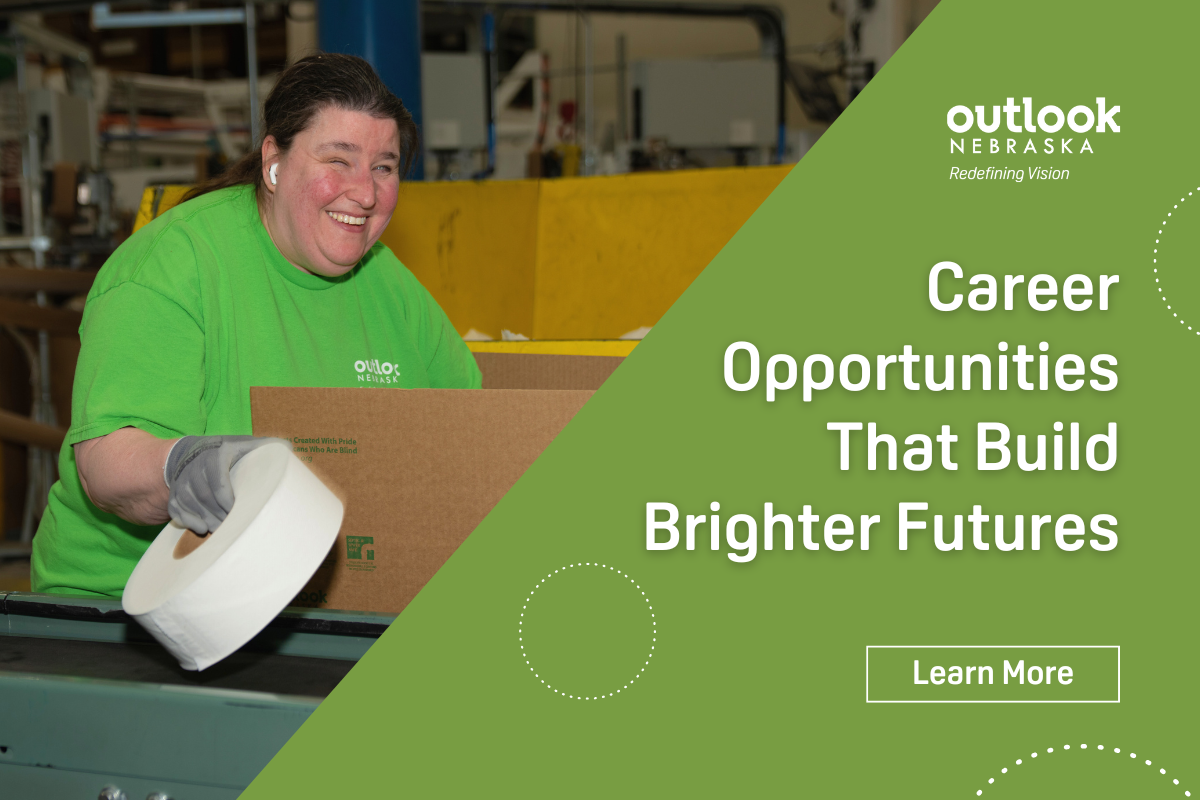
Terra is packing toilet paper on the manufacturing floor. "Career Opportunities That Build Brighter Futures - Learn More."


This Veterans Day, we honor Josh and all who have served. When asked what advice he would give to fellow veterans facing similar challenges, Josh said, “There are organizations that can help you. Your biggest obstacle is yourself.” Regarding his experience working at Outlook Nebraska, he added: “Outlook Nebraska lets you succeed and grow as much as you want to and are capable of.”

If you or a loved one is a blind or visually impaired veteran seeking support, whether through our community programs or employment, we’re here to help. Please complete our Employment Interest Form or contact Outlook Enrichment to get in touch.

Let’s continue to uplift and empower those who have sacrificed so much in service to our country.

What a Patient and an Optometrist Want You to Know About Eye Exams

Interviews With:

Dr. Kyle Niemann, OD – Optometrist, Visual Eyes Optical
Megan Mackie – Community Events Coordinator, Outlook Enrichment


In the rush of daily life, it’s easy to overlook the small things, like visions. This sense is something many of us take for granted, until it begins to change.

In this blog, we share two unique perspectives on eye care: one from a patient and one from an optometrist. Their experiences together highlight the importance of routine eye exams and provide a deeper understanding of the diagnostic process from both sides of the exam room.


An Optometrist Shares What to Expect at an Eye Exam

When was the last time you had a comprehensive eye exam? Optometrists (OD) see hundreds of patients each year and recommend that everyone, whether blind, visually impaired, or without current vision concerns, receive a comprehensive exam annually. Why? Many eye diseases can progress silently, with little to no early symptoms, making regular checkups essential for protecting long-term eye health.

“Many of the traditional tests we perform during a regular comprehensive exam may need to be adapted to accommodate the level of visual impairment. One key difference between a low vision exam and a regular exam is how a refraction is performed. Visually impaired individuals may not notice subtle changes, so during the refraction, the doctor will need to determine the level at which the patient can detect a difference. The doctor will then arrive at glasses or contacts that may give you the most visual benefit,” explains Dr. Kyle

Vision loss exists on a spectrum. Some individuals are completely blind with no light perception, while others may be legally blind, have low vision, or simply need corrective lenses. In some cases, changes in vision may signal an underlying medical condition, such as diabetic retinopathy, macular degeneration, cataracts, or glaucoma, which are among the leading causes of vision impairment and blindness. Regardless of where someone falls on that spectrum, maintaining eye health is crucial for overall well-being.

Another critical component within the low vision exam is monitoring disease progression through several scans of the back part of the eye and optic nerve. These scans ensure that the disease is stable and not showing signs of rapid or dangerous changes. Patients may be referred to an ophthalmologist (OMD) for specialized treatment if their eye condition requires advanced care. In other instances, lifestyle adjustments may help slow the progression of vision loss, although a clear solution is not always present.

“Typically, a diagnosis is fairly straightforward with a simple update to the patient’s prescription. However, for patients with a visual impairment, the start of the conversation may be a bit different. One of the most important aspects of my approach is maintaining empathy for the patient. When dealing with sight-threatening diseases, it’s crucial to understand the patient’s situation and clearly explain the symptoms they may experience. I especially emphasize the importance of follow-up care to ensure stability of the disease and to prevent rapid progression. Many patients receive handouts, pamphlets, or are directed to a website for additional education. Outlook Enrichment has been a vital resource for patients struggling with daily activities, and it’s empowering to know there’s a place that can truly support and guide them,” shares Dr. Kyle.


A Patient’s Ongoing Journey with Diabetic Retinopathy

Growing up with diabetes, Megan Mackie was always aware that vision loss could be a potential complication. However, it wasn’t until she turned 28 that she noticed significant changes in her eyesight, which made it challenging to see at school and work. After failing an eye exam at the DMV, she realized it was time to visit an eye doctor.

“Initially, I could drive myself to the appointments. It all became routine: paperwork, then the waiting room. After being called back, I’d stop at a few machines for pictures of my eyes, receive dilation eye drops, wait in a dark room, and then proceed to the exam room. Repeating my eyesight status at every appointment became frustrating, and I was nervous about reading the eye chart because I could not accept that my eyesight was declining,” Megan explains.

At this point, she had been diagnosed with diabetic retinopathy and had already experienced a retinal detachment in the center of one eye. She noticed “floaters,” blobs of blood from the blood vessels in her eyes. Blood vessels continued to grow, blood flow worsened to her optic nerve, and she developed a severe case of band keratopathy.

“If this all sounds like a foreign language to you, it did to me, too. The details went in one ear and out the other,” Megan admits.

Initially, she felt hopeful. With various medical recommendations presented, the outcome seemed optimistic. But the following year, the retina in her “good” eye also detached. Her doctor scheduled surgery to attempt a reattachment, but there was little guidance beyond the medical side of things. No one explained how she would manage her daily life without vision, how to pay bills, access transportation, navigate Social Security and Medicaid, or continue working. In the beginning, Megan had to rely heavily on her family, who were facing the same uncertainties.

After several surgeries, Megan realized her vision had become even more limited than before. The treatments had taken a toll on her eyes, and there wasn’t anything more her doctor could do. The only option left was to manage her blood sugar and blood pressure, her best and only chance at preserving the little sight remaining.

At the time, Megan didn’t know anyone else who was blind, and everyday tasks quickly became overwhelming. She struggled to distinguish one eye drop bottle from another, draw up her insulin injections, and read or pay bills. She was scared to leave the house; the offers of help with transportation had ceased, and the idea of returning to work felt impossible.

“It wasn’t until I discovered the resources available for people with vision loss that I was able to rebuild my life physically, mentally, and financially slowly. At some point, I had to accept my vision loss journey. I realized I would be responsible for taking the necessary steps to move forward. The Nebraska Commission for the Blind and Visually Impaired (NCBVI) helped me learn cane travel, introduced me to public transportation, and supported me with job searching. Becoming employed at Outlook was a huge relief. I was able to get off state assistance, and they even had a resource advisor who could answer my Social Security questions with my best interests in mind. Looking back, had I been informed about resources available at the same time as my diagnosis, I could have started the recovery process sooner with more support,” she reflects.


Connecting Patients to Vision Loss Resources and Services

For someone who is blind or visually impaired, visiting the eye doctor requires extra planning. Patients must schedule transportation, navigate unfamiliar spaces, and fill out paperwork, all of which can take much longer than for the average patient. Many rely on adaptive technology, such as screen readers, closed-circuit televisions (CCTVs), or smartphone apps, to help complete these basic tasks.

Despite these challenges, the support patients receive often ends at the diagnosis. Patients like Megan are rarely given clear guidance on what comes next, and while that may not fall entirely on the doctor’s shoulders, even a small gesture of direction can make a meaningful difference. That’s where organizations like Outlook Enrichment come in.

Something as simple as a brochure or business card can provide valuable guidance for someone navigating a sudden loss of vision. These resources offer patients a tangible takeaway during a challenging time, serving as a starting point for their journey.

We act as a bridge between diagnosis and the next step of their journey, whether that means discovering adaptive technology, learning new life skills, regaining independence, or finding a community of individuals who truly understand their experiences.

As advocates for individuals with vision loss, we’re also working to educate eye care providers about this often-overlooked aspect of care. By collaborating with optometrists, ophthalmologists, and clinic staff, we aim to build stronger referral pathways and ensure patients are connected to the resources and support they need as early as possible.

Together, we can create a more informed, compassionate, and empowering continuum of care, one that doesn’t stop at diagnosis but supports every step that follows.
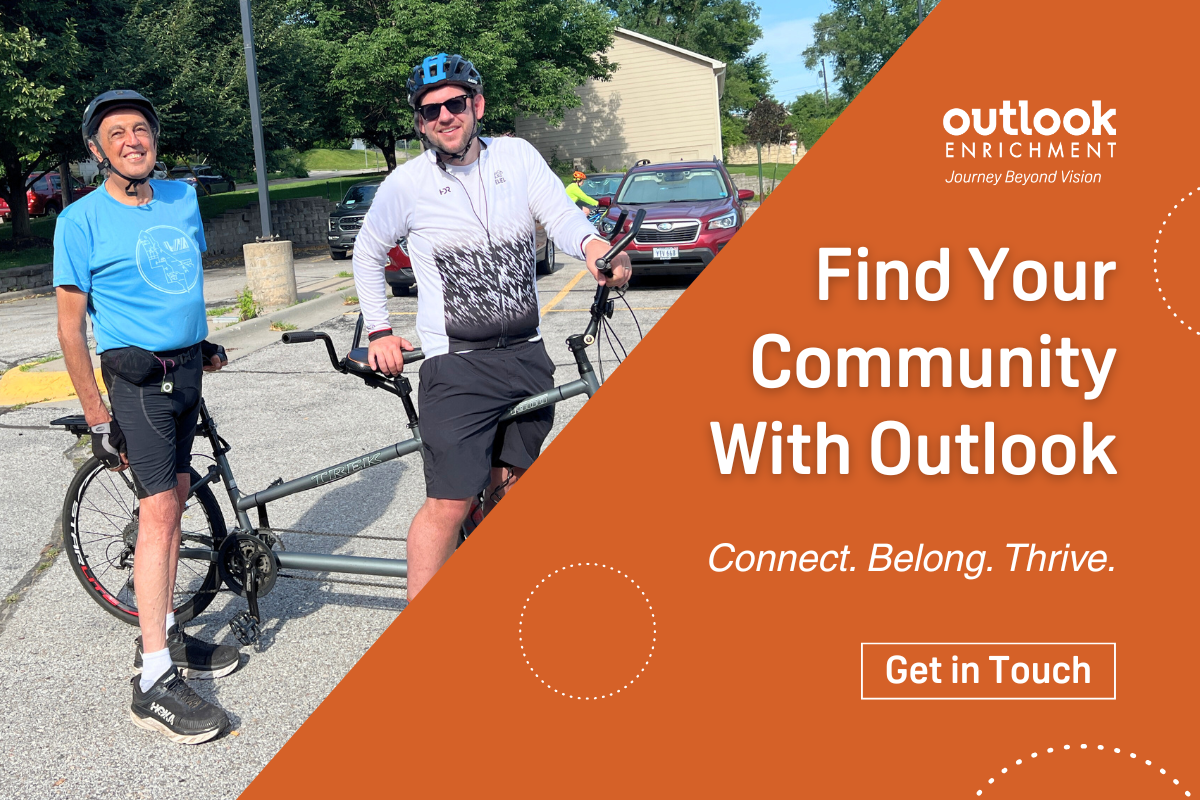
 

Two adult men smiling on a tandem bike. "Find Your Community With Outlook - Connect. Belong. Thrive. Get in Touch."


Vision loss is life-changing, but it doesn’t have to define your life. As we’ve seen through Megan’s story and Dr. Kyle’s insights, a diagnosis is only one step of the journey. What follows, access to resources, emotional support, and the ability to adapt, makes all the difference.

If you or someone you know is facing vision loss, remember that you’re not alone. Outlook Enrichment is here for you when you need us. Ready to take the next step? Get in touch with our team today.

Honoring Outlook Associates & the Power of Peer Support

In this episode, we sit down with Outlook Nebraska’s 2025 Associate of the Year, Morie Dinovo, First Shift Team Facilitator, and the Outlook Nebraska 2025 Peter J. Salmon Associate of the Year, Mortel Crawford, Second Shift Finisher. They share insights into their roles and time at Outlook, and what this recognition means to them.

We’re also joined by Ross Pollpeter, Program Facilitator at Outlook Enrichment, who offers a behind-the-scenes look at our peer support groups. He’s joined by Tim Green, an Outlook Enrichment client, who opens up about his personal journey with vision loss and how he got connected with Outlook. Together, Ross and Tim discuss the importance of keeping support groups peer-led and how these spaces foster meaningful community and connection.

Celebrating Two Decades of Dedication With Ben Micek

This year, we’re honored to celebrate a very special milestone, Ben Micek’s 20th anniversary at Outlook Nebraska. Ben has been an essential part of our team for two decades, and his journey exemplifies both personal and professional growth, as well as the importance of creating equal opportunity for individuals from all backgrounds. Having been with Outlook since nearly the beginning, Ben has a unique perspective on how far the organization has come from moving locations and expanding shifts to launching new products and programs. He’s been here through it all.


How Early Support Systems Empowered Ben’s Journey

Ben’s journey with vision loss began at birth. He was born blind in his right eye and with no peripheral vision in his left. While the exact cause is unknown, he believes it may be genetic. Later, at age 18, he was also diagnosed with glaucoma, an eye disease that causes damage to the optic nerve, leading to vision loss over time. His family believes his diagnosis may have been triggered by the stress of undergoing multiple surgeries during childhood. Fortunately, there are treatments today that help slow or prevent vision loss from the disease.

His Individualized Education Program (IEP) ensured he had the accommodations and tools needed to succeed academically. Support from the Nebraska Commission for the Blind and Visually Impaired (NCBVI) provided orientation and braille training in his early high school years, helping him build essential skills for independence. Throughout it all, his family offered constant encouragement, reinforcing his confidence and determination to thrive.

It was NCBVI who first connected Ben with Outlook Nebraska through its Work and Gain Experience in the Summer (WAGES) program in 2005. At the time, he was looking to gain real-world work experience and connect with others in the blind and visually impaired (BVI) community. The six-week program, designed for BVI youth ages 16–21, offers job training along with skill-building and social opportunities.


Creating a Long-Term Career at Outlook Nebraska

Ben joined Outlook Nebraska when the organization was just five years old, working out of its former I Street location before the move. He recalls a highly collaborative environment where everyone wore multiple hats, shared workspaces, and came together to support one another as the organization’s mission took shape.

Today, Ben serves as an Accounting Associate, a role he’s held throughout his time at Outlook. He plays a key role in Outlook’s financial operations, managing accounts payable and handling bill payments for Outlook Nebraska and its related entities. “I knew nothing about accounting or Excel when I started,” Ben says. “Everything I’ve learned, I’ve learned here.” This year, he led the rollout of a new electronic filing system, a significant initiative that replaced outdated processes and helped streamline operations across departments. To support his daily work, adaptive technologies such as ZoomText, CCTVs, and VoiceOver are his go-tos.

Among Ben’s favorite memories at Outlook is being named Associate of the Year and traveling to Washington, D.C. to attend a National Industries for the Blind (NIB) conference. Reflecting on what has meant the most to him during his career, Ben shares, “Just having Outlook see me as me. They don’t define me by my visual impairment; they see my potential.”


Ben’s Path to Self-Advocacy and Higher Education

Ben’s journey at Outlook has shaped him in many ways. “I’ve become more confident and outgoing,” he shares. “The people here definitely played a part in that, beyond just teaching me new skills.” Following the loss of his father, Ben experienced a major turning point in his life that led to even greater personal growth. “I had to reinvent myself,” he says. “I became my own advocate, something I wasn’t able to do when I was younger.”

In 2024, Ben earned his associate’s degree in Business and General Studies, fulfilling a goal he had been considering for some time. He credits a conversation with a fellow Outlook associate for giving him the push he needed to enroll at Metropolitan Community College. “If you have the drive and the right support system, whether that’s family or an organization, chase your dream if it’s what you want,” he says.

Having lived these experiences, Ben hopes more individuals in the BVI community are given the same opportunities. “Give people a second chance, or give more people who are BVI a first chance, by finding jobs or opportunities for them,” he says.


A female Outlook Nebraska associate is placing toilet paper into a box. Text: "Creating Opportunity. Transforming Lives. Together we're redefining vision. Let's connect."


Over the years, Ben has become a reliable figure for our associates, not only due to his dedication to his role but also because of his sense of humor, positivity, and perspective. Ben has consistently demonstrated what is achievable when individuals are empowered to grow, learn, and feel a sense of belonging. His voice and experiences are vital parts of our history, and we are grateful for the insights he has shared with us. Ben, thank you for 20 years of loyalty, impact, and heart. We’re lucky to have you on our team.

Want to help create more stories like Ben’s? Learn how you can support Outlook’s mission of positively impacting everyone who is blind or visually impaired through employment and community programs. Get involved today!