
Jessica Wilson Named Outlook Nebraska’s 2026 Associate of the Year

When Jessica Wilson’s coworkers nominated her for Associate of the Year, it reflected the journey she’d been on since joining Outlook Nebraska.

“It tells me that my work matters,” Jessica says. “That people notice I’m willing to help, collaborate, and get the job done every day.”

Jessica has spent three years at Outlook Nebraska, where she currently works on the Spartan Chemical line, helping bottle janitorial cleaning and disinfectant products for purchase by the Federal Government. What Jessica found at Outlook was more than just a job—it was a chance to grow, challenge herself, and prove what she could achieve.


Jessica’s Path to Outlook Nebraska

Jessica and her family moved to Nebraska during the COVID-19 pandemic to be closer to relatives in Bellevue and to seek new opportunities. After researching Outlook Nebraska, her husband Chris applied and joined the team. A few years later, when their youngest daughter started kindergarten, Jessica decided it was time to rejoin the workforce after being a stay-at-home mom.

With no prior manufacturing experience, Jessica wasn’t sure what to expect. Jessica started on the converting floor as a Finisher I before being offered a role on the Spartan Chemical production line. Rather than shy away from an unfamiliar role, she embraced the opportunity.

That willingness to learn has defined Jessica’s time at Outlook. Along the way, she’s gained confidence, developed new skills, and takes pride in continuously improving her work.

Looking ahead, Jessica is enthusiastic about the future of our janitorial cleaners and disinfectants. With a new filling machine on the way and more products being added to the line, she’s optimistic about the department’s ongoing growth.

“I’m excited and hopeful that the Spartan side can grow as big as the paper side,” she says.


Living with Vision Loss: Congenital Nystagmus and Strabismus

Jessica was born premature with congenital nystagmus, a condition that weakens the eye muscles and causes involuntary shaking of the eyes. She also has strabismus, which causes her eyes to shift outward (exotropia) and misalign, affecting both her depth perception and visual acuity. With 20/200 vision, Jessica has peripheral vision but cannot see clearly at a distance and must get close to read print or see objects. She uses magnification tools, including ZoomText, to help with daily tasks.

Jessica attended public school until seventh grade before attending the Arkansas School for the Blind, where she stayed through her senior year. It was the first time she met other people with vision loss and learned how to apply the skills she had been taught to everyday life. It was also where she met her husband, Chris.

After graduating, Jessica studied social work at the University of Arkansas at Little Rock but ultimately decided to focus on raising a family. Aside from a seasonal retail position at Target, Outlook Nebraska has been her first long-term career.


Raising a Family as a Blind Parent

Jessica is raising two daughters, both thriving in school, and says day-to-day parenting hasn’t looked much different for her family. Her parents never treated her differently than her sighted sibling growing up, and she’s carried that same approach into raising her own kids, who are both fully sighted.

The biggest obstacle, she says, is transportation. She doesn’t drive, so she relies on rideshare services like Uber to get to the store or to doctor’s appointments, which means planning everything well in advance.

“I feel like I am always on someone else’s time,” Jessica says.

If there’s one thing Jessica wants people to understand, it’s that vision loss doesn’t define what someone is capable of.

“I wish there wasn’t so much stigma around vision loss,” she says. “I wish people were more educated and less quick to write off what we can do. We can do what a sighted person can—you just have to give us the opportunity and let us show you, especially in the workplace.”
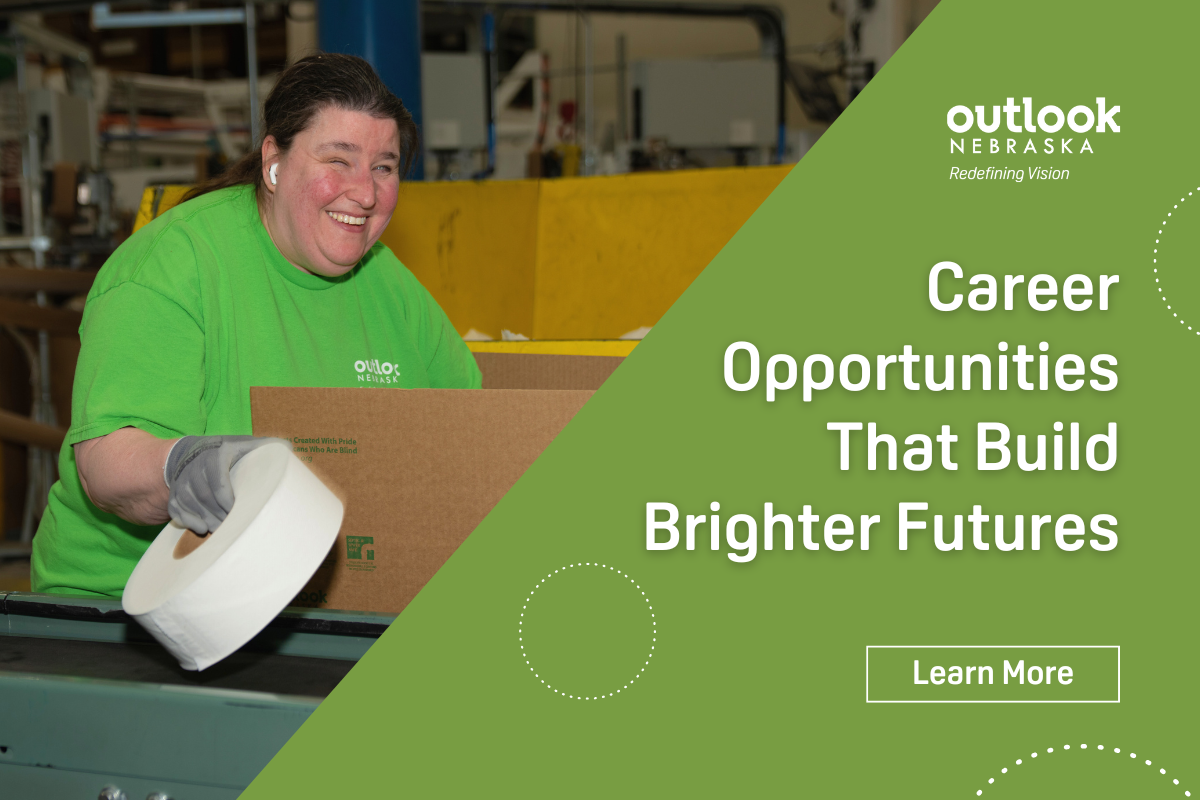
 

Terra is packing toilet paper on the manufacturing floor. "Career Opportunities That Build Brighter Futures - Learn More."


Between work and raising her daughters, Jessica admits she doesn’t have much free time, though she’d love to get more involved in Outlook Enrichment’s community events when she can. For now, she’s focused on what’s in front of her: doing good work, continuing to grow into her role, and supporting her fellow associates.

Congratulations to Jessica Wilson, Outlook Nebraska’s 2026 Associate of the Year.


Curious about opportunities at Outlook Nebraska? Submit a General Employment Interest Application, or share this with someone who’d be a great fit.
The Early Days of Outlook Nebraska with Janis Compton

In this episode, we welcome Janis Compton, a well-known figure in the history of Outlook Nebraska. As the organization’s first receptionist, Janis wore many hats, stepping in wherever she was needed and helping lay the foundation for what Outlook has become today.

She shares a glimpse of her role, reflects on Outlook’s early days, and discusses what makes it such a special place to work. Janis also gives us an update on what she’s up to now and a few of her favorite hobbies that keep her busy.

Creating a Workplace Culture Where Inclusion Drives Empowerment

In episode 11 of Outlook On-Air, we sit down with Julia Lockett, Accounting Specialist at Union Pacific, who shares her journey with vision loss and the role Outlook Enrichment has played in her life. She also offers heartfelt advice and talks about becoming an advocate for coworkers experiencing vision loss.

Teresa Selden, Julia’s boss and Revenue Account Manager – International Intermodal, at Union Pacific, also joins us. Teresa discusses the importance of open communication, ensuring Julia has access to the latest adaptive technology, and creating a workplace culture rooted in empathy, collaboration, and support.

Their story reminds us that accessibility fuels possibility. Workplaces that prioritize inclusion unlock potential, drive success, and embody what National Disability Employment Awareness Month is all about.

The Power of Adaptation in Recreation & Life

In this episode, we’re joined by Dr. Michael Messerole and Glen Wragge from the University of Nebraska at Omaha’s School of Health and Kinesiology. Both have played a key role in shaping Outlook Enrichment’s Adaptive Recreation Program.

They share the creative challenges and rewarding moments they’ve encountered while working with youth who are blind or visually impaired, and how these experiences have reshaped the way they teach, plan, and think about inclusion in physical activity.

We’re also joined by Keli O’Dell, a machine operator at Outlook Nebraska who has been part of our team for seven years. Born with cataracts that led to lifelong low vision, Keli opens up about his journey and what working at Outlook has meant to him personally and professionally.

How Outlook Is Changing Lives Through Vision Rehabilitation & Employment

Vision Rehabilitation Week falls in June, a time to spotlight the millions of Americans navigating vision loss and the powerful services that help them live fuller, more independent lives. At Outlook, we witness every day how the right tools, training, and opportunities can transform lives. Vision loss may alter how someone experiences the world, but it doesn’t have to limit their independence, confidence, or sense of purpose.

Together, Outlook Nebraska and Outlook Enrichment offer a full spectrum of programs designed to employ, educate, and empower individuals who are blind or visually impaired. We’re on a mission to redefine what’s possible.


Understanding the Need for Vision Rehabilitation

More than 12 million Americans age 40 and older live with some form of vision impairment, a number expected to double by 2050 (JAMA Ophthalmol, 2016). Despite these growing numbers, awareness of vision rehabilitation remains low, with less than 5% of those who could benefit from these services receiving them (VisionServe Alliance, 2025).

Vision loss can significantly impact daily life, affecting everything from emotional health and mobility to employment, independence, and social connections. Without proper support, individuals often face higher risks of depression, isolation, and unemployment. 28.9% of working-age people with vision impairment report being unable to work compared to just 6.3% of those without vision impairment (VisionServe Alliance, 2023). These numbers highlight a significant gap in services and a compelling opportunity to make a meaningful difference. With the right support systems, individuals can regain their independence and improve their quality of life.

Vision rehabilitation refers to a comprehensive range of services that help individuals with vision loss adapt to daily life, maintain their independence, and continue to participate in the activities they love. These services are essential for reducing dependence on others, improving overall well-being, and increasing employability and financial independence.


Building Confidence Through Community & Skills Learning

At Outlook Enrichment, we’re committed to helping individuals who are blind or visually impaired realize they can do more than they ever imagined. Our six core programs — adaptive technology, independent living, recreation, arts and culture, work readiness, and health and wellness — are designed to support individuals at every stage of their vision loss journey. They are essential components of vision rehabilitation.

One of the things that makes Outlook Enrichment special is that our trainers are blind or visually impaired themselves. They bring empathy and experience to their work, showing participants what’s possible and creating a welcoming, judgment-free space. Whether someone is learning to navigate a new smartphone, preparing a meal safely at home, staying active with adaptive fitness, or finding joy through art and music, our services help restore confidence and create connections. Every program is designed to empower individuals with practical tools and a strong community, ensuring they not only adapt but also thrive.

Most of our programs are offered free of charge, made possible by the generous support of donations and grants. The only exceptions are recreation and arts and cultural activities, which may include a small fee to help cover materials or admission costs. We rely on the support of our community to sustain these life-changing services and to help raise awareness so that more people know these resources are here when they need them.

“Outlook has become family for me. The support has given me the confidence to accept what’s going on and to be able to be like this out in the world,” says client Samantha Randall.


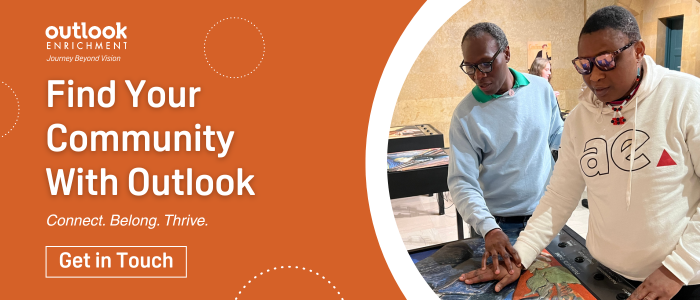
"Find Your Community With Outlook. Connect. Belong. Thrive. Get in Touch." Photo of a man guiding a woman at a tactile art event.


Creating Fulfilling Career Paths for People With Vision Loss

While Outlook Enrichment equips individuals with essential life and career skills, Outlook Nebraska provides rewarding employment opportunities for those who are blind or visually impaired. Employment is a crucial, often overlooked aspect of the rehabilitation journey, providing individuals with structure, income, and purpose after experiencing vision loss. There’s pride in earning a paycheck, contributing, and being a part of a supportive community of peers who share similar experiences.

That’s why Outlook Nebraska is proud to be a part of the AbilityOne Program. This federal initiative creates job opportunities for people who are legally blind or have other significant disabilities through the sale of products and services. Outlook Nebraska produces SKILCRAFT and Spartan products, including toilet paper, paper towels, and cleaners and disinfectants, which are purchased by the U.S. Government, including the military, federal prisons, national parks, and other agencies.

What makes Outlook Nebraska truly unique is its fully accessible facility, purposefully designed to support its associates. On the manufacturing floor, tools such as audio-equipped machines, 70-inch Human-Machine Interface (HMI) touchscreens, color-coded and textured flooring, and nonvisual box labeling systems help employees navigate and operate machinery with confidence. These features empower more than 75% of our direct labor force, who are blind or visually impaired, to perform their roles effectively and safely. In administrative roles, associates utilize adaptive technology, such as screen readers and closed-circuit televisions (CCTVs), which are popular tools selected based on personal preference.

“Outlook is the reason I get up in the morning,” says associate Josh Scarborough, a U.S. military veteran who has been with the organization since 2011. “This organization provides you with all the opportunities to succeed if you take them.”


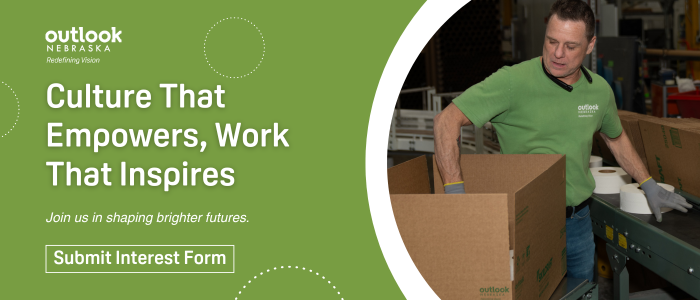
Graphic with Outlook associate placing toilet paper into a box. Text: "Culture That Empowers, Work That Inspires - Every role at Outlook contributes to our mission of positively impacting everyone who is blind or visually impaired. Submit Interest Form"


Vision Rehabilitation Week is about more than raising awareness. It’s about taking action. It’s a reminder that vision loss doesn’t have to mean losing independence, opportunity, or connection. Through the life-changing programs at Outlook Enrichment and the meaningful employment opportunities at Outlook Nebraska, we’re empowering individuals to live fuller, more confident lives.

If you or someone you know is facing vision loss, know that support is available, and it works. Request more information about our programs or submit a General Employment Interest Application.


References

Varma, R., Vajaranant, T.S., Burkemper, B., Wu, S., Torres, M., Hsu, C., Choudhury, F. and McKean-Cowdin, R. (2016). Visual impairment and blindness in adults in the United States: demographic and geographic variations from 2015 to 2050. JAMA Ophthalmology, 134(7), pp.802-809.

VisionServe Alliance. (2025). Vision Rehabilitation Week 2025.https://visionservealliance.org/visionrehabilitationweek2025/

VisionServe Alliance (2023). The Prevalence and Characteristics of People Aged 18 to 64 Years with Blindness and Low Vision, United States, 2019, Behavioral Risk Factor Surveillance System, St. Louis.