Jane’s Journey with LHON

On this episode of Outlook On-Air, we wrap up a few loose ends before welcoming Jane, an Outlook Enrichment client, to the conversation. She shares her experience of losing her vision rapidly in 2022 due to Leber Hereditary Optic Neuropathy (LHON), a genetic condition passed through the maternal line.

Jane walks us through what her vision looks like today and how she got connected with Outlook Enrichment for support and resources along the way. She also reflects on how her vision loss temporarily put her hobbies on hold, and how she’s since found new ways to adapt and regain independence, from using her cane and smartphone to exploring tools like Meta glasses and navigating grocery shopping.

Getting a Guide Dog with Alex France


In this episode, Alex France shares his journey with retinitis pigmentosa and how he’s adapted as his vision has changed, including his decision to apply for a “running guide dog.”

Now partnered with Marina, Alex shares how she’s become an important part of his day-to-day life. He also discusses the responsibilities of being a guide dog handler, the application process, and how guide dogs differ from using a white cane.

Plus, Janis Compton returns to answer a listener’s question.

Living Life on Her Own Terms: Julie Lintzman’s Story

Julie Lintzman is no stranger to vision loss or to Outlook Enrichment’s programs, but lately, she’s been smiling ear to ear and feeling lighter, with a renewed sense of possibility. We are so grateful to be part of this chapter in her journey. After facing vision loss and a season of overwhelming hardship, Julie made a choice: she would live on her own terms. What followed was a journey of courage, community, and newfound confidence.


Balancing Work, Family, and Vision Loss

Healthcare has always been a part of Julie’s life; she graduated from Immanuel School of Nursing in 1976 and began her career as a rehabilitation nurse. With a rewarding job, a husband, and a son, her life felt full and typical until, at 37, she began to notice changes in her vision.

Years later, Julie would connect with Outlook Enrichment at a health fair at Baxter Arena, but at that time, she was just beginning to understand how much her life was about to change. A visit to the eye doctor led to a diagnosis of retinitis pigmentosa (RP), a chronic eye condition with no cure that can eventually lead to total blindness. RP progresses gradually, and as Julie’s vision declined, the demands of clinical nursing became harder to manage.

For the last 15 years of her career, Julie transitioned into the insurance field, reviewing fraud claims. She admits that coping with these changes was not easy. As her vision continued to decline, her family’s needs only grew. Having spent much of her life as a caretaker, Julie found herself losing touch with her own well-being while supporting her husband through chronic health challenges and her son through mental health struggles.


Finding Community During Life’s Hardest Season

To fill her own cup, Julie became a regular participant in Outlook Enrichment’s art workshops, finding both creativity and connection. But another obstacle soon appeared. Living outside public transportation routes meant she relied on her husband for rides, and as his health worsened, her options for transportation became increasingly limited.

She adapted by finding ways to escape without leaving her home, such as doing yardwork and reading books. During the height of COVID-19, Julie also became a familiar face in our virtual programming. She joined the Audiobook Club and virtual game nights, often the first to log on and the last to leave. Even through a screen, she found community.

As her husband’s health declined and he began requiring full-time care, the weight Julie was carrying grew heavier. Without reliable transportation or support, daily life became increasingly difficult to navigate as her vision loss progressed. When her husband entered hospice care, Julie made the difficult decision to relocate to an assisted living facility.

In a short span of time, her son was incarcerated, her husband passed away, and she was diagnosed with cancer, requiring radiation treatments. It was a year filled with grief and challenges. Yet Julie has survived the storm, and in the aftermath, she has made space for something new: joy.


At 71, Julie Embraces a New Chapter

Today, Julie is 71 years old, and she wears it as a badge of honor. Last summer, she stepped far outside her comfort zone. A recent party patio ride was, in her words, “the best time I can remember having in a long time.” Axe throwing? “A hoot.” She even pedaled 10 miles on a tandem bike ride. Her perspective has shifted in a powerful way, “I’m going to live my life the way I want to now, and I’m not looking back. My only regret is not starting to do this earlier.

Through Outlook Enrichment’s peer support groups and recreational activities, Julie has begun to recognize just how capable she is. She enjoys asking questions about adaptive technology, working through issues with her smartphone, meeting new people, and receiving encouragement to try public transportation.

My favorite activity is riding MOBY. I don’t know what I was always so scared of. I tend to overthink things and focus too much on the pros and cons. Turns out there really are no cons besides maybe having to wait a little while, but I’ve got nothing but time. I don’t even mind being the last one dropped off, I’d like to ride around all day,” she shared.


A male client practicing cane travel with a male trainer. "Be Supported on Your Journey - Contact Us."


With the support of the Outlook team and the community she has built, Julie has come to an empowering realization: if others who are blind or visually impaired are out doing things, she can do them too. Here’s to the beginning of many new adventures, bigger smiles, and lasting memories. Julie, we are so proud of you.

If you or someone you know could benefit from Outlook Enrichment’s programs and services, we would love to connect and explore how we can help support your goals.

Understanding the Difference Between Assistive and Adaptive Technology

Individuals with disabilities often depend on various tools to enhance their independence and participation in everyday life. In discussions about accessibility, two terms frequently arise: assistive technology and adaptive technology. While these terms are sometimes used interchangeably, this blog outlines their key differences and explains why that distinction matters as technology becomes more inclusive.


What is Assistive Technology?

According to the Assistive Technology Industry Association (ATIA), assistive technology refers to any item, system, or product used to improve the functional capabilities of individuals with disabilities. These tools are not always explicitly designed for individuals with disabilities; often, they are popular products that can be repurposed or modified for accessibility.

Common examples of assistive technology include:

These technologies not only offer everyday convenience but also play a vital role in supporting independence.


What is Adaptive Technology?

Adaptive technology is considered a subcategory of assistive technology. The key distinction lies in intent and design: adaptive technology refers to devices or equipment created specifically for individuals with disabilities. These are tools that someone without a disability would not typically use.

Common examples of adaptive technology include:

Adaptive technologies are often key to enhancing quality of life, as they provide the tools individuals with disabilities need to engage in learning, working, and living independently.


Outlook trainer, Isaac, works with a male client on computer typing skills.


As mainstream technologies increasingly incorporate built-in accessibility features, the line between assistive and adaptive technologies is blurring. Voice control and magnification tools, once considered specialized, are now common features on smartphones, tablets, and computers. This shift represents progress toward a more inclusive future.

If you or someone you know is seeking recommendations for accessibility or adaptive technologies, Outlook Enrichment is here to help. Call us at 531-365-5051 to learn more about our programs or to get personalized recommendations.

A Guide to Accessible Transportation Services in the Omaha Metro Area

One of the most common challenges we hear from associates and clients who are blind or visually impaired is transportation. Reliable, accessible transportation is crucial for maintaining independence, whether it’s getting to work, attending medical appointments, or staying connected to the community.

Fortunately, there are several transportation options available throughout Omaha and the surrounding areas that cater specifically to individuals with disabilities and senior citizens. In this blog, we highlight three categories of services: local special transit services, Metro Transit Omaha, and ride-share and app-based services.
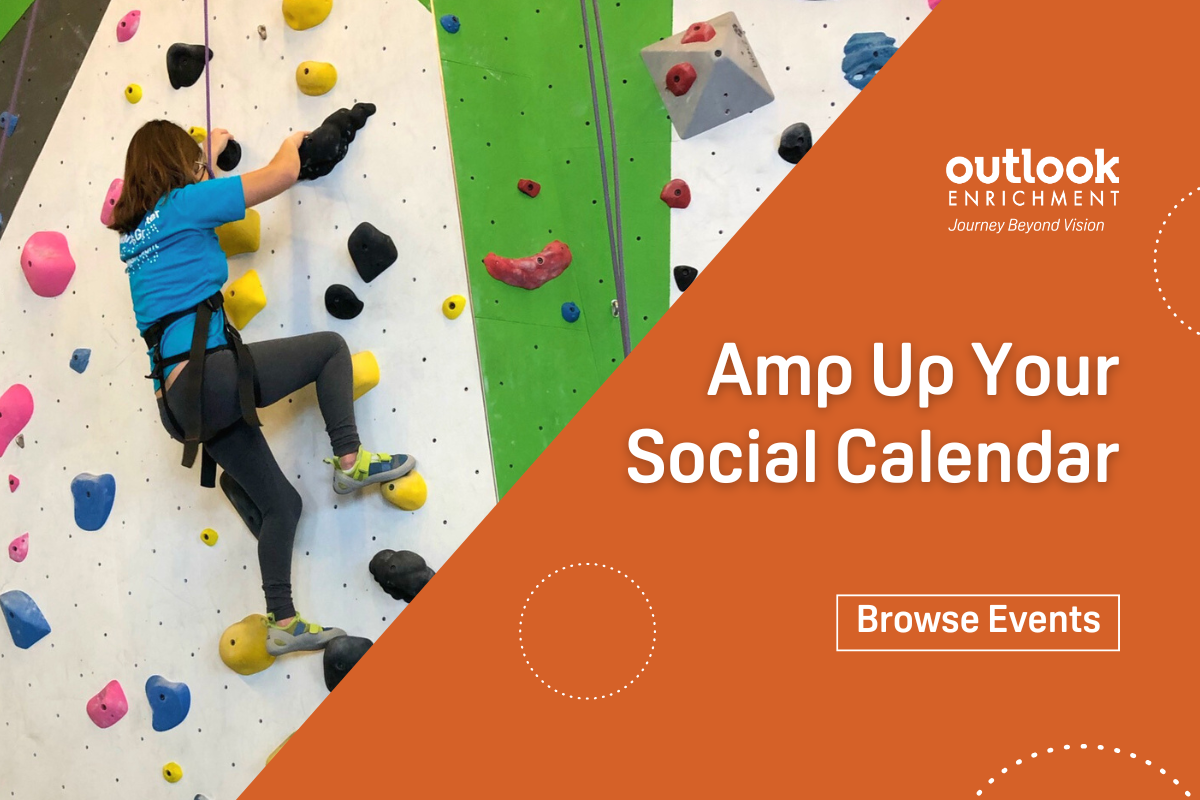
 

"Amp Up Your Social Calendar - Browse Events." A young girl is rock climbing in the graphic.


Special Transit Services Outside of Omaha

Several cities near Omaha provide accessible transportation options primarily for seniors and individuals with disabilities. These services typically require riders to submit applications and make reservations in advance. Cost, travel locations, and operating hours may vary by provider.


La Vista – Ralston Special Services Bus

The La Vista – Ralston Special Services Bus prioritizes work and medical-related trips for senior citizens and individuals with disabilities residing in these areas.

To learn more about the La Vista – Ralston Special Services Bus, click here or call 402-657-3550.


Papillion Special Transportation Services

Papillion Special Transportation Services is an on-demand service subsidized by the State of Nebraska for elderly and disabled residents of Papillion, including those in surrounding SIDs.

To learn more about Papillion’s Special Transportation Services, click here or call 402-680-3970.


Bellevue’s Specialized Transportation Service

Bellevue’s Specialized Transportation Service offers scheduled transportation to destinations in Bellevue and Omaha for senior and disabled residents.

To learn more, call 402-293-3138 to receive an informational brochure and application.


Ponca

Ponca Express offers transportation services for both Native and non-Native individuals. It operates across several Nebraska cities and is available for a wide range of purposes, including medical appointments, education, and recreation.

To learn more about Ponca Express, click here or call 1-877-769-3111 for Ponca Express Rural or 855-766-2239 for Ponca Express Metro.


Council Bluffs Special Transit Service

Council Bluffs Special Transit Service offers accessible transportation for individuals with disabilities who are unable to use standard city buses.

To learn more about Council Bluffs Special Transit Service, click here or call 712-890-5296.


Getting Around Omaha with Metro Transit Services

Metro Transit offers a range of public transportation services throughout Omaha, including traditional bus routes and newer on-demand programs such as Metro Flex, as well as an ADA-compliant paratransit service called MOBY.


Metro Bus System

The Metro bus system includes over 2,100 stops across the Omaha area.

Download from the App Store or Download from the Google Play Store

To learn more about the Metro Bus System, click here.


Metro Flex

Launched in 2025, Metro Flex is a pilot on-demand service that connects riders to nearby bus routes and transit centers.

To learn more about Metro Flex, click here.


ORBT

ORBT is Metro’s streamlined bus service offering faster rides.

To learn more about ORBT, click here.


MOBY

MOBY is Metro’s ADA complementary paratransit service for individuals who can’t access Metro’s fixed route bus network due to a disability or disabling health condition.

To learn more about MOBY, click here or call 402-341-7560, ext. 2520 for assistance.


Ride-Share and App-Based Transportation Options

If public transportation isn’t the right fit for you, ride-share apps and taxi-style services provide additional flexibility.


Uber

Uber is one of the most popular ride-share apps, allowing you to schedule a ride instantly or in advance.

To learn more or download the app, click here.


Lyft

Lyft offers features similar to Uber, with real-time and scheduled rides available through its app.

To learn more or download the app, click here.


zTrip

zTrip is a taxi-style ride service available in Omaha.

To learn more about zTrip or download the app, click here.


Share a Fare

Share A Fare is a transportation reimbursement program for individuals who are legally blind or whose vision prevents them from driving.

To learn more about Share a Fare, click here.
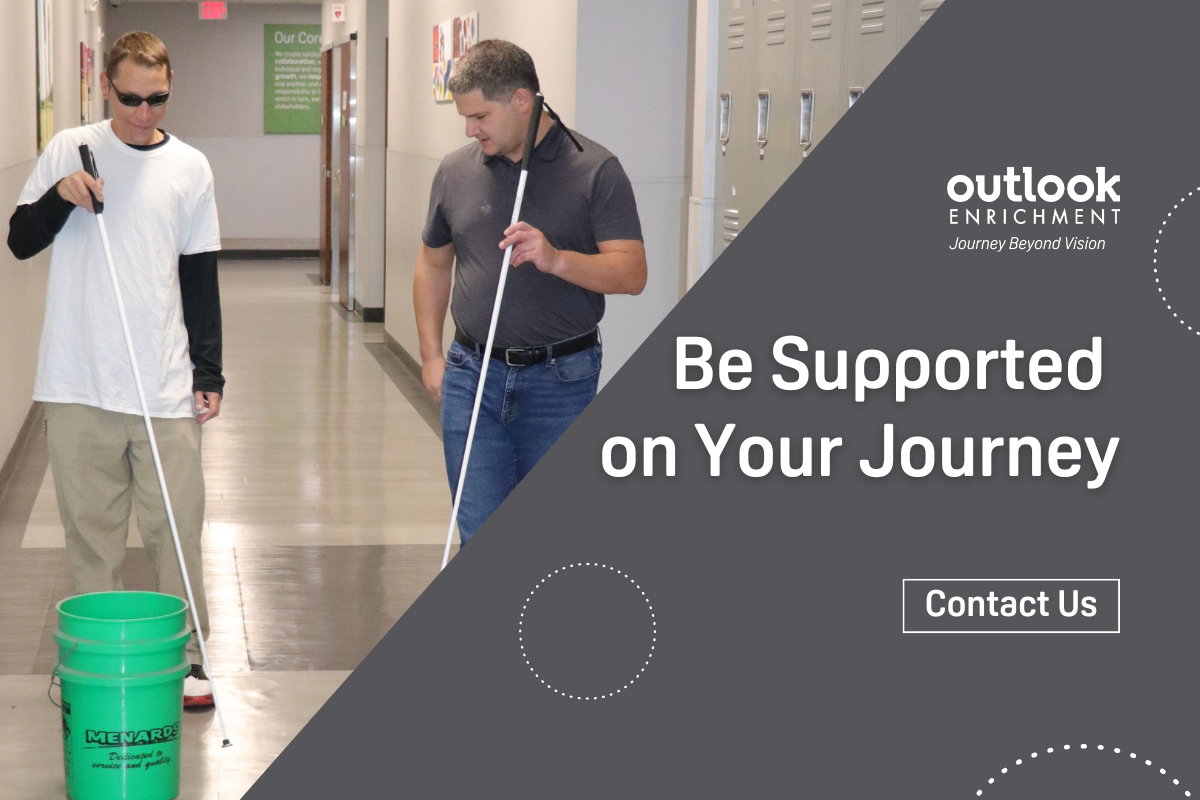
 

A male client practicing cane travel with a male trainer. "Be Supported on Your Journey - Contact Us."


Accessible transportation is essential for staying active, independent, and connected to your community. Whether you’re in Omaha or a neighboring city, there are a variety of options designed to support your mobility needs and busy schedule.

If you or someone you know is blind or visually impaired and needs help navigating transportation options, Outlook Enrichment is here to help. Our Resource Advisor can guide you through the available programs, assist with applications, and help you find the best tools to support your lifestyle. Complete our contact form to get started.

Meet the Enrichment Team: Isaac Grelk

Isaac Grelk understands firsthand the challenges of adjusting to life with vision loss, but he also knows how to thrive despite it. Now, as an Adaptive Technology Trainer at Outlook Enrichment, he’s using his lived experience to support others on their journey toward independence, confidence, and connection. Read on to learn how his journey led him to empowering others.


Isaac’s Early Signs and Diagnosis of Stargardt Disease

Isaac’s vision loss first became apparent to his parents when he struggled to connect with the ball during little league baseball. After two years of tests, he was diagnosed with Stargardt disease, a genetic eye condition that leads to a fatty buildup in the macula, affecting central vision. He explained that both of his parents are gene carriers, and one of his siblings has also been affected. While his vision has remained stable over the years, he acknowledges that it could change with age. Isaac describes his vision as similar to looking around a fist held in front of his nose, explaining that he has a blind spot in the center of his field of vision.

After moving to Omaha in 2016, he was first connected with Outlook Enrichment when his mother discovered the organization online. It provided him with a great opportunity to make new friends who are also blind or visually impaired during high school and to stay active in recreational programs.

Isaac later attended the University of Nebraska at Omaha (UNO), where he earned a bachelor’s degree in kinesiology. When asked why he chose that path, he said, “I always liked helping people achieve their goals, whether fitness-related or something personal.”


Embracing Blindness and Finding Personal Success

One of Isaac’s greatest ongoing challenges has been transportation. For a long time, it was difficult for him to get around independently, as he had to rely on his wife or services like Uber or Lyft, which could be costly. This changed when he moved to La Vista and discovered the La Vista-Ralston Special Services Shuttle. He was grateful for a simple application process, having only to fill out a form and hand it to the driver on his first ride. This smaller, more localized service has provided greater flexibility, and the drivers have even learned his routine, so he no longer needs to call ahead to schedule each ride.

In terms of personal growth, Isaac has had several milestones worth celebrating:


Empowering the Blind Community Through Community Programs

Towards the end of college, Isaac’s involvement with Outlook Enrichment deepened when he took on an internship with Outlook Enrichment as part of his practicum at UNO. He landed the internship after an associate overheard him on a tour saying, “This would be a neat place to work.” That small moment turned into a big opportunity.

During his internship, he taught CrossFit classes to clients through our health and wellness program. He also trained his peers to adapt workouts and to follow proper etiquette when interacting with individuals who are blind or visually impaired.

After completing his internship and graduating from college, Isaac transitioned to the manufacturing floor at Outlook Nebraska, gaining experience on the employment-focused side of our organization. When an Adaptive Technology Trainer position opened at Enrichment, he knew it would be a perfect fit.

Today, Isaac works directly with clients, teaching them to navigate technology using accessibility features such as screen readers, voice commands, typing tools, AI, and more. When asked what he enjoys most about the role, Isaac didn’t hesitate:

“The moment clients realize they can independently use their phone again, that ‘ah-ha’ moment is the best.” He always reminds them, “You can do a lot more than you think you can.”


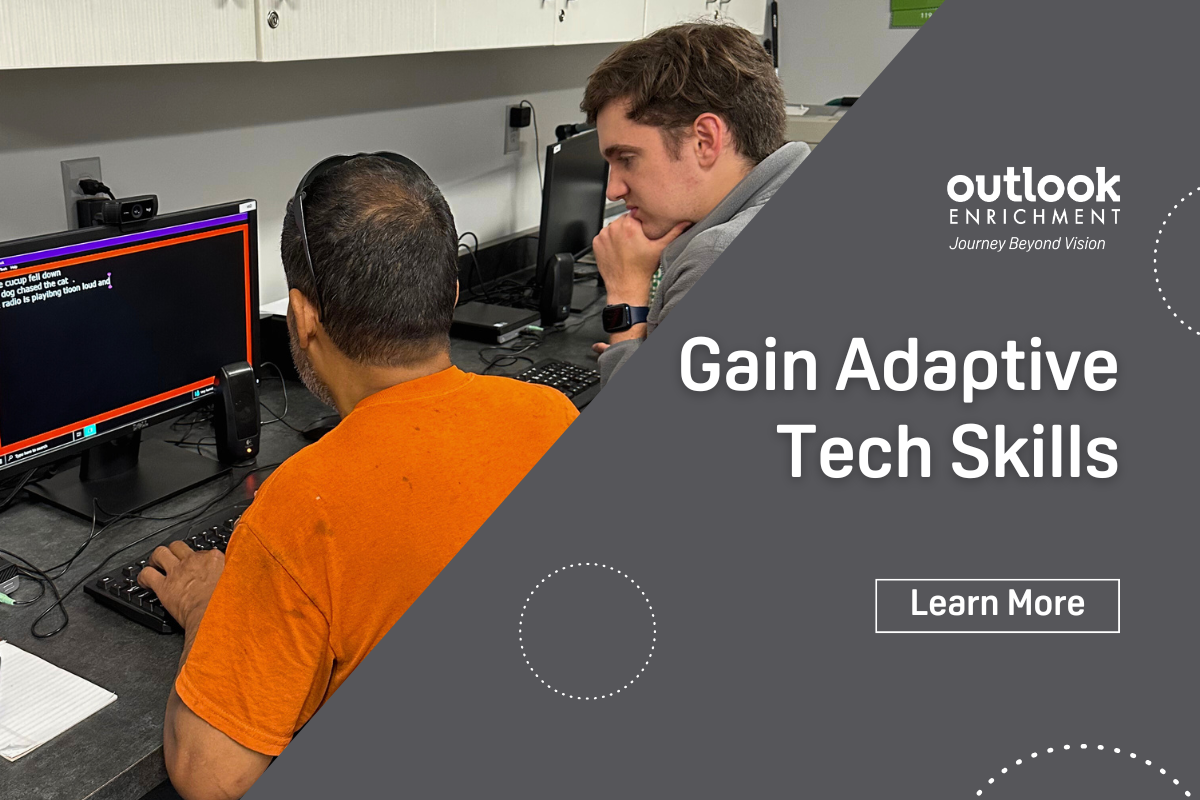
Outlook trainer, Isaac, works with a male client on computer typing skills.


Isaac’s story is a powerful reminder that vision loss doesn’t define a person; it simply reshapes how they experience the world. From learning to adapt at a young age to becoming a trusted tech trainer at Outlook Enrichment, he has embraced his identity and now helps others do the same on their journeys towards independence.

Interested in training with Isaac? Let’s get in touch!