What a Patient and an Optometrist Want You to Know About Eye Exams

Interviews With:

Dr. Kyle Niemann, OD – Optometrist, Visual Eyes Optical
Megan Mackie – Community Events Coordinator, Outlook Enrichment


In the rush of daily life, it’s easy to overlook the small things, like visions. This sense is something many of us take for granted, until it begins to change.

In this blog, we share two unique perspectives on eye care: one from a patient and one from an optometrist. Their experiences together highlight the importance of routine eye exams and provide a deeper understanding of the diagnostic process from both sides of the exam room.


An Optometrist Shares What to Expect at an Eye Exam

When was the last time you had a comprehensive eye exam? Optometrists (OD) see hundreds of patients each year and recommend that everyone, whether blind, visually impaired, or without current vision concerns, receive a comprehensive exam annually. Why? Many eye diseases can progress silently, with little to no early symptoms, making regular checkups essential for protecting long-term eye health.

“Many of the traditional tests we perform during a regular comprehensive exam may need to be adapted to accommodate the level of visual impairment. One key difference between a low vision exam and a regular exam is how a refraction is performed. Visually impaired individuals may not notice subtle changes, so during the refraction, the doctor will need to determine the level at which the patient can detect a difference. The doctor will then arrive at glasses or contacts that may give you the most visual benefit,” explains Dr. Kyle

Vision loss exists on a spectrum. Some individuals are completely blind with no light perception, while others may be legally blind, have low vision, or simply need corrective lenses. In some cases, changes in vision may signal an underlying medical condition, such as diabetic retinopathy, macular degeneration, cataracts, or glaucoma, which are among the leading causes of vision impairment and blindness. Regardless of where someone falls on that spectrum, maintaining eye health is crucial for overall well-being.

Another critical component within the low vision exam is monitoring disease progression through several scans of the back part of the eye and optic nerve. These scans ensure that the disease is stable and not showing signs of rapid or dangerous changes. Patients may be referred to an ophthalmologist (OMD) for specialized treatment if their eye condition requires advanced care. In other instances, lifestyle adjustments may help slow the progression of vision loss, although a clear solution is not always present.

“Typically, a diagnosis is fairly straightforward with a simple update to the patient’s prescription. However, for patients with a visual impairment, the start of the conversation may be a bit different. One of the most important aspects of my approach is maintaining empathy for the patient. When dealing with sight-threatening diseases, it’s crucial to understand the patient’s situation and clearly explain the symptoms they may experience. I especially emphasize the importance of follow-up care to ensure stability of the disease and to prevent rapid progression. Many patients receive handouts, pamphlets, or are directed to a website for additional education. Outlook Enrichment has been a vital resource for patients struggling with daily activities, and it’s empowering to know there’s a place that can truly support and guide them,” shares Dr. Kyle.


A Patient’s Ongoing Journey with Diabetic Retinopathy

Growing up with diabetes, Megan Mackie was always aware that vision loss could be a potential complication. However, it wasn’t until she turned 28 that she noticed significant changes in her eyesight, which made it challenging to see at school and work. After failing an eye exam at the DMV, she realized it was time to visit an eye doctor.

“Initially, I could drive myself to the appointments. It all became routine: paperwork, then the waiting room. After being called back, I’d stop at a few machines for pictures of my eyes, receive dilation eye drops, wait in a dark room, and then proceed to the exam room. Repeating my eyesight status at every appointment became frustrating, and I was nervous about reading the eye chart because I could not accept that my eyesight was declining,” Megan explains.

At this point, she had been diagnosed with diabetic retinopathy and had already experienced a retinal detachment in the center of one eye. She noticed “floaters,” blobs of blood from the blood vessels in her eyes. Blood vessels continued to grow, blood flow worsened to her optic nerve, and she developed a severe case of band keratopathy.

“If this all sounds like a foreign language to you, it did to me, too. The details went in one ear and out the other,” Megan admits.

Initially, she felt hopeful. With various medical recommendations presented, the outcome seemed optimistic. But the following year, the retina in her “good” eye also detached. Her doctor scheduled surgery to attempt a reattachment, but there was little guidance beyond the medical side of things. No one explained how she would manage her daily life without vision, how to pay bills, access transportation, navigate Social Security and Medicaid, or continue working. In the beginning, Megan had to rely heavily on her family, who were facing the same uncertainties.

After several surgeries, Megan realized her vision had become even more limited than before. The treatments had taken a toll on her eyes, and there wasn’t anything more her doctor could do. The only option left was to manage her blood sugar and blood pressure, her best and only chance at preserving the little sight remaining.

At the time, Megan didn’t know anyone else who was blind, and everyday tasks quickly became overwhelming. She struggled to distinguish one eye drop bottle from another, draw up her insulin injections, and read or pay bills. She was scared to leave the house; the offers of help with transportation had ceased, and the idea of returning to work felt impossible.

“It wasn’t until I discovered the resources available for people with vision loss that I was able to rebuild my life physically, mentally, and financially slowly. At some point, I had to accept my vision loss journey. I realized I would be responsible for taking the necessary steps to move forward. The Nebraska Commission for the Blind and Visually Impaired (NCBVI) helped me learn cane travel, introduced me to public transportation, and supported me with job searching. Becoming employed at Outlook was a huge relief. I was able to get off state assistance, and they even had a resource advisor who could answer my Social Security questions with my best interests in mind. Looking back, had I been informed about resources available at the same time as my diagnosis, I could have started the recovery process sooner with more support,” she reflects.


Connecting Patients to Vision Loss Resources and Services

For someone who is blind or visually impaired, visiting the eye doctor requires extra planning. Patients must schedule transportation, navigate unfamiliar spaces, and fill out paperwork, all of which can take much longer than for the average patient. Many rely on adaptive technology, such as screen readers, closed-circuit televisions (CCTVs), or smartphone apps, to help complete these basic tasks.

Despite these challenges, the support patients receive often ends at the diagnosis. Patients like Megan are rarely given clear guidance on what comes next, and while that may not fall entirely on the doctor’s shoulders, even a small gesture of direction can make a meaningful difference. That’s where organizations like Outlook Enrichment come in.

Something as simple as a brochure or business card can provide valuable guidance for someone navigating a sudden loss of vision. These resources offer patients a tangible takeaway during a challenging time, serving as a starting point for their journey.

We act as a bridge between diagnosis and the next step of their journey, whether that means discovering adaptive technology, learning new life skills, regaining independence, or finding a community of individuals who truly understand their experiences.

As advocates for individuals with vision loss, we’re also working to educate eye care providers about this often-overlooked aspect of care. By collaborating with optometrists, ophthalmologists, and clinic staff, we aim to build stronger referral pathways and ensure patients are connected to the resources and support they need as early as possible.

Together, we can create a more informed, compassionate, and empowering continuum of care, one that doesn’t stop at diagnosis but supports every step that follows.


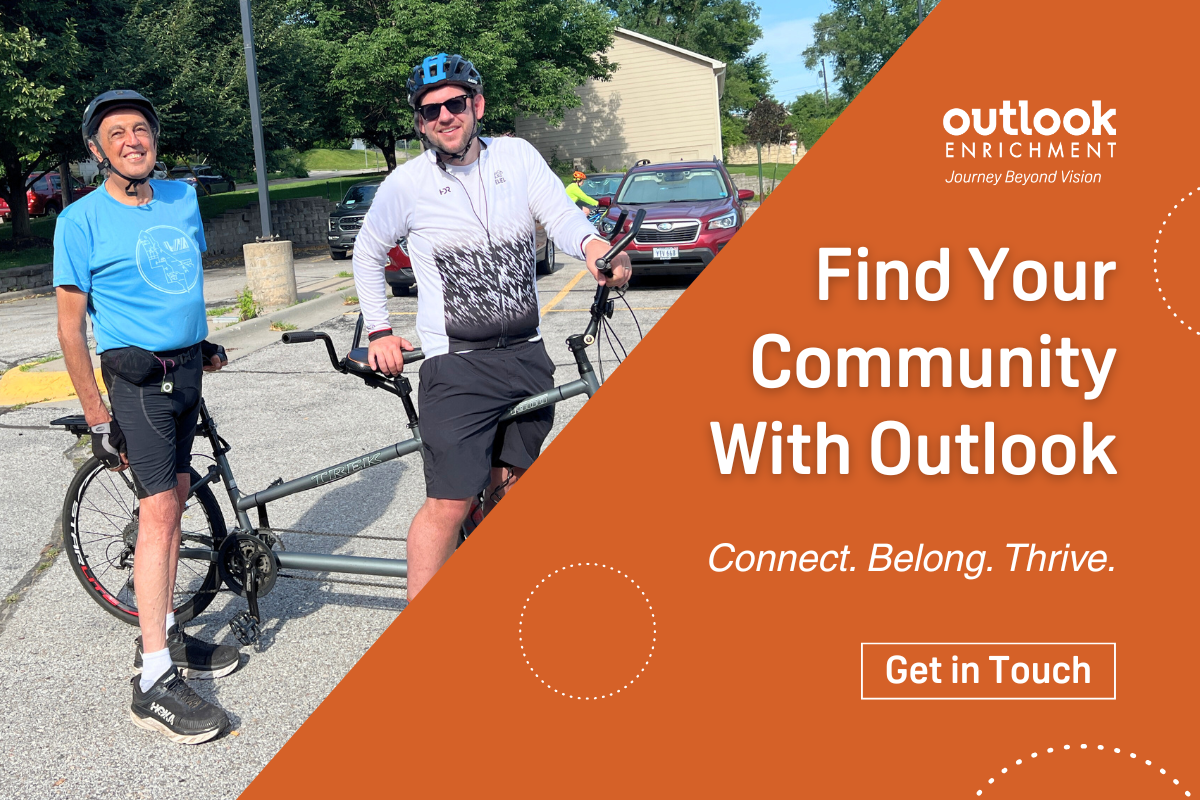
Two adult men smiling on a tandem bike. "Find Your Community With Outlook - Connect. Belong. Thrive. Get in Touch."


Vision loss is life-changing, but it doesn’t have to define your life. As we’ve seen through Megan’s story and Dr. Kyle’s insights, a diagnosis is only one step of the journey. What follows, access to resources, emotional support, and the ability to adapt, makes all the difference.

If you or someone you know is facing vision loss, remember that you’re not alone. Outlook Enrichment is here for you when you need us. Ready to take the next step? Get in touch with our team today.

Honoring Outlook Associates & the Power of Peer Support

In this episode, we sit down with Outlook Nebraska’s 2025 Associate of the Year, Morie Dinovo, First Shift Team Facilitator, and the Outlook Nebraska 2025 Peter J. Salmon Associate of the Year, Mortel Crawford, Second Shift Finisher. They share insights into their roles and time at Outlook, and what this recognition means to them.

We’re also joined by Ross Pollpeter, Program Facilitator at Outlook Enrichment, who offers a behind-the-scenes look at our peer support groups. He’s joined by Tim Green, an Outlook Enrichment client, who opens up about his personal journey with vision loss and how he got connected with Outlook. Together, Ross and Tim discuss the importance of keeping support groups peer-led and how these spaces foster meaningful community and connection.

Vision Loss Support That Empowers: Outlook Enrichment’s Approach to Living Fully

Did you know that 12.5 million Americans over age 40 experience vision loss? By 2050, the number of Americans who are blind or have vision loss is expected to increase by 118% (VisionService Alliance, 2022). But behind every statistic is a person on their own unique path, facing new challenges and celebrating small wins as they adjust to living with vision loss. At Outlook Enrichment, we’re here to make that journey feel less intimidating.


Group at a table for an in person support group session. Text: "Be Supported on Your Journey. Join us for our weekly virtual peer support group sessions." Contact Us link.


Personalized Support for Every Stage of Vision Loss

At Outlook Enrichment, we aspire to assist our neighbors who are blind or dealing with vision loss in living independently, engaging confidently in their communities, and continuing to pursue their passions. “When people lose their vision, they think ‘I can’t,’” Program Facilitator Ross Pollpeter says. “You can, soon. Maybe you feel this way now, but let us show you how you can do things differently.”

We support people at every stage of their journey, whether newly diagnosed or have lived with vision loss for years. We understand that no two journeys with vision loss are the same. Every client we serve has unique goals and needs, which is why our training is always personalized. We meet clients where they are and stand by them every step of the way.


Community Connections Through Events and Experiences

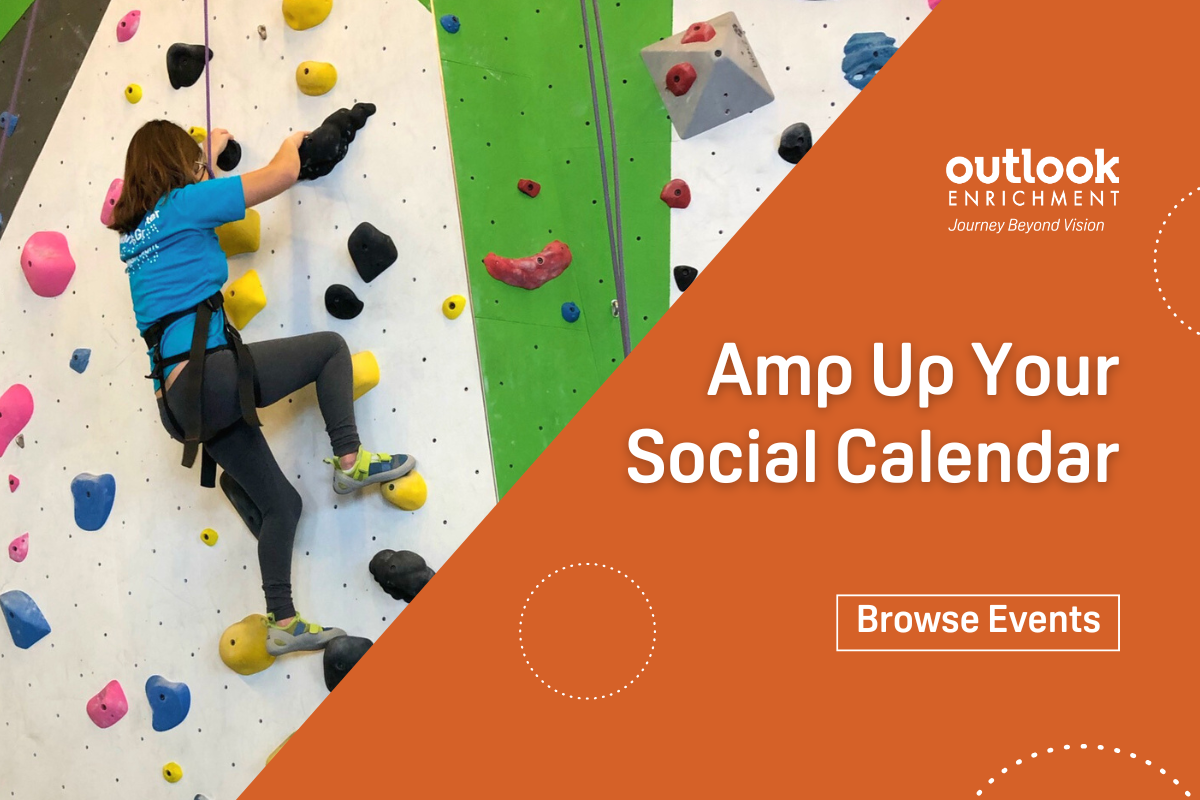
In addition to training and support, we offer meaningful opportunities for social connection. “We are all about getting people connected,” says Isaac Grelk, Adaptive Technology Trainer. “We meet people where they are. Blind people are capable of all things. Our goal is to guide them through it.” We help people build the skills they need while connecting them to a supportive community. Our inclusive community events encourage clients to step out and try new things. Some of our most popular events are our tandem bike club, bowling bash, and holiday lights tour.

We also provide health-focused education, including adaptive CrossFit classes and accessible meal preparation, focusing on simple, nutritious meals. “We bring in high protein food that does not require clients to dice a lot of ingredients,” shared Grelk, who recently graduated with an exercise science degree from the University of Nebraska at Omaha. “We encourage them to eat healthy, and it tastes good.”


How Adaptive Technology Can Transform Daily Life

For many, adaptive technology is the bridge to independence. Whether it’s staying connected with loved ones, maintaining a career, or managing daily tasks, the right tools can make a world of difference. Our tech trainers, who are also blind or visually impaired, bring lived experience to every session, helping clients build confidence in using assistive tools and devices. It also goes a long way in building trust from the start. “We try to set people up to have a positive experience in training,” Pollpeter said. “It helps to have that connection and develop that network.”

Some of the tools we introduce to clients are:


Fostering a Welcoming, Inclusive Environment

Vision loss can be isolating, especially for seniors or individuals managing additional health conditions. We do everything possible to foster an environment where people feel seen, supported, and included. Our peer support groups, offered virtually and in person, give clients a safe space to share experiences, learn from each other, and build relationships.

We also understand that many of our clients live with secondary disabilities such as diabetes, stroke, hypertension, heart disease, or hearing impairment. “We have a lot of clients with secondary disabilities,” says Pollpeter. “If a client needs adjustments, we’ll work to accommodate them. Our goal is to make them feel inclusive and empowered to live their best life.”


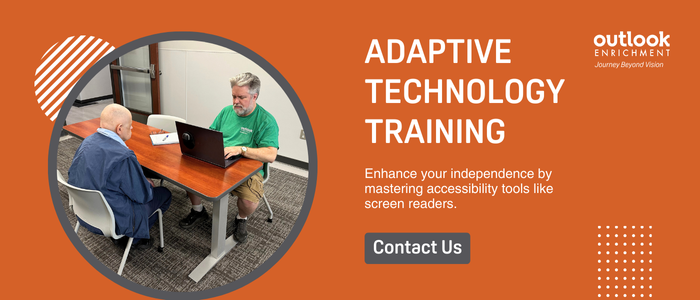
Enrichment Adaptive Tech Trainer, Dennis, working with Outlook Nebraska associate on utilizing adaptive tech skills on a laptop. "Enhance your independence by mastering accessibility tools like screen readers. Contact Us."


At Outlook Enrichment, we believe that vision loss doesn’t mean giving up on the life you want. It just means adapting and finding a new path forward. Everyday, we witness people rediscover their independence, passions, and confidence. Whether learning to use a new piece of tech, making a healthy meal, or joining a recreational outing, our clients and associates show what’s possible when you have the proper support.

Ready to take the next step or want to learn more? Complete our contact form or call 531-365-5051.


References

VisionServe Alliance (2022). Nebraska’s Older Population and Vision Loss: A Briefing, St. Louis.

Job Placement Services

Client-Based Services

We provide personalized support to help individuals with vision loss prepare for, secure, and thrive in their roles. Services include:


Customized Training

Each session is tailored to focus on a specific topic or skill set, providing one-on-one support designed to meet the unique needs of each client. Participants receive practical guidance, real-world tips, and personalized strategies to help them gain confidence and grow professionally.

In addition to individual training, we offer group classes that create opportunities for collaborative learning and peer modeling. As the instructor presents information, class members suggest or talk about the challenges they have faced. Through peer modeling, individuals see that they are not alone.


Support for Employers

Employers will have access to client-based services for technical assistance on employment law, reasonable accommodations, barrier identification and removal strategies, and adaptive technology and accessibility tools.

Peer Support Groups

About

Vision loss can be a traumatic experience, often bringing on feelings of grief and loss as individuals adjust to a new way of life. At Outlook Enrichment, our support group provides a space for individuals with vision loss to process these changes, connect with others, and build a path forward together.

Open to anyone navigating vision loss, the group is peer-led and supported by individuals who are also blind or visually impaired. Support group sessions take a holistic approach, exploring how vision loss affects various aspects of life and relationships, personally and within the broader community. Many discussions are framed around wellness models like the Wellness Wheel, including emotional, intellectual, physical, social, environmental, financial, and spiritual wellness. Sessions may also focus on trust, confidence, self-esteem, interpersonal relationships, and more.


Peer Modeling

Alongside the facilitator, long-time participants often take an active role in shaping the conversation. They often suggest discussion topics and occasionally lead sessions. Past conversations have explored themes like alternative health, loneliness, developing trust, stigma, and isolation.

Your Journey to Independent Living

About

Outlook Enrichment launched its Independent Living program in the fall of 2020. Early virtual sessions focused on essential safety topics, such as cleaning procedures, using safety precautions when using sighted guides, and adaptive aids for labeling and organization.

In 2021, we expanded our services to include monthly virtual workshops on independent living skills such as safe cooking and home organization. By 2022, the program grew to offer in-home training and small group classes, allowing us to better meet individuals where they are literally and figuratively.


How It Works

Independent living training is available in person and virtually to accommodate each client’s preferences and needs. Sessions begin with a personalized assessment to determine the client’s current level of independence, including skills like safe cooking techniques, time/money management, labeling/organization tips, and medication management tools and aids.

Once the assessment is completed, the participant and trainer establish specific goals that the client works toward. All training is completed at the client’s pace while skills are developed and objectives are met toward the independent living goal.

Remote, independent-living skills classes focus on a specific topic or skill set. These group classes are open to anyone interested in gaining knowledge, tips, and tricks from peers with vision loss.

Schedule Training